 Skip to main content
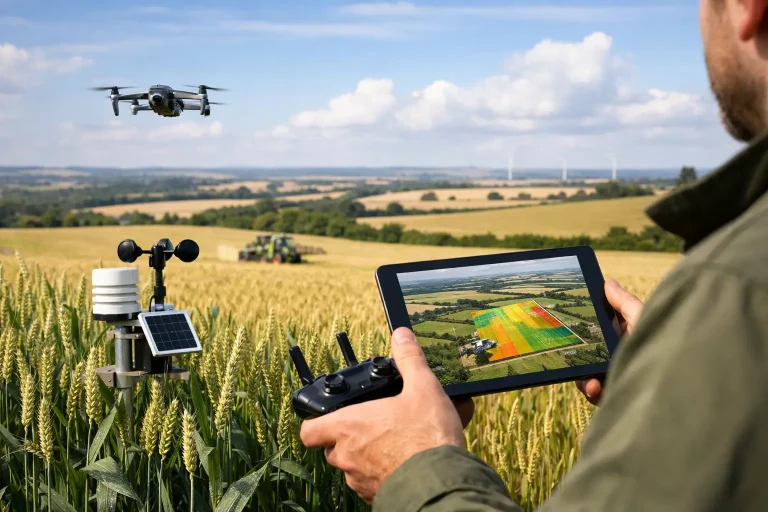
A wheat field can look uniform from the gate and still be underperforming in three different ways. One area may be holding water, another may be short on nitrogen, and a third may simply be lagging because of compaction. That is exactly why crop monitoring for UK farming has moved from a nice-to-have to a practical management tool for progressive growers and land managers.
The challenge is not a lack of information. It is getting the right information early enough to act on it. Walked inspections still matter, but they only show part of the picture and they take time. Satellite data can be useful for broad trends, yet cloud cover, revisit timing and lower resolution often limit what can be seen when decisions need to be made quickly. Drone-based monitoring adds a different level of visibility – high-resolution, field-specific and available when conditions on the ground demand a closer look.
Why crop monitoring for UK farming matters now
Margins are tight, weather patterns are less predictable, and input costs remain under pressure. That combination has changed the value of crop intelligence. Monitoring is no longer just about identifying obvious crop failure. It is about understanding variation across a field before that variation turns into lost yield, wasted fertiliser, unnecessary spraying or preventable drainage work.
For UK farms, this matters because field conditions can vary sharply over short distances. Soil type, slope, drainage history, traffic patterns and localised pest or disease pressure all influence performance. Two parts of the same field can behave very differently after a wet fortnight or a dry spell in late spring. Treating that field as one uniform block is often where efficiency starts to slip.
Good monitoring makes those differences visible. More importantly, it helps turn them into decisions. That might mean prioritising a ground inspection in a weak patch, checking whether irrigation is reaching the right zones, or confirming whether a recurring problem aligns with historic drainage lines. The value is in the response, not just the image.
What effective crop monitoring actually needs to show
Not every map is useful. For monitoring to support commercial decisions, the output needs to be clear, accurate and tied to real agronomic questions. If a grower or land manager cannot identify what the issue is, where it starts and how extensive it is, the data has limited operational value.
A strong monitoring approach should reveal crop variability in enough detail to distinguish between patterns caused by moisture, nutrient availability, establishment problems, compaction or infrastructure constraints. It should also make repeat surveying possible, so conditions can be compared over time rather than judged from a single snapshot.
This is where higher-resolution aerial data stands apart. Multispectral imagery can detect plant stress before it is obvious to the eye, while photogrammetry and terrain modelling can show how topography, surface movement and drainage behaviour may be affecting crop development. In practice, those layers are often more powerful together than in isolation.
The role of drones in crop monitoring for UK farming
Drone surveying gives farms and land managers a way to inspect crops with far greater precision than a standard visual check. Flights can be planned around specific fields, pressure points or timings in the season, rather than waiting for the next usable satellite pass. That control matters when windows for intervention are short.
The main advantage is detail. A drone survey can capture subtle changes in crop vigour across a field, identify emerging stress zones and support accurate comparison between blocks, tramlines and management areas. Because the imagery is geo-referenced, it can also be aligned with drainage plans, irrigation layouts, previous survey data or field operations records.
That matters beyond arable farming alone. Turf professionals, estate managers and specialist land-management teams face similar questions around plant health, water movement and input efficiency. The same principles that support crop performance also apply to managed green spaces where quality, consistency and drainage are commercially significant.
What can aerial crop monitoring reveal?
The most immediate benefit is earlier visibility of stress. A crop may show reduced vigour because of waterlogging, poor root development, nutrient imbalance, pest activity or disease pressure. From ground level, these issues can be hard to separate or even to spot at all until they have progressed. From above, the pattern often tells the first part of the story.
If stress follows low-lying ground, blocked outfalls or old drainage routes, the cause may be structural rather than nutritional. If the issue appears in patches related to previous trafficking, compaction becomes more likely. If crop development changes along application widths or management boundaries, input distribution may need checking. Monitoring does not replace agronomy or field inspection, but it makes those inspections far more targeted.
The strongest results usually come when aerial outputs are used to direct action on the ground. Instead of walking an entire field with uncertainty, teams can go straight to the areas showing the most unusual behaviour. That saves time and improves the quality of decision-making.
Where growers often lose value
The common mistake is treating monitoring as a one-off image capture rather than a decision-support process. A single flight may show where the crop is weak, but if that information is not compared with terrain, drainage features, previous performance or follow-up surveys, the commercial value stays limited.
Another issue is resolution without interpretation. Many businesses can provide aerial imagery. Fewer can deliver outputs that are accurate enough and clear enough to support practical land management. Precision matters here. If stress zones, boundaries or infrastructure overlays are not spatially reliable, it becomes harder to plan intervention with confidence.
That is why survey discipline is important. Flight planning, sensor choice, ground control, processing quality and presentation all affect whether the final output becomes useful working data or just a visually impressive map.
From plant health maps to operational decisions
When monitoring is done properly, it feeds directly into field strategy. A plant health map may lead to a targeted inspection for disease. A recurring weak strip may justify drainage investigation. Uneven vigour around irrigation infrastructure may point to coverage or pressure issues. In some cases, the result is a variable input plan. In others, it confirms that the real problem sits below the crop.
This is where a consultative approach has far more value than generic image capture. The best aerial data services are designed to answer operational questions, not simply produce outputs. For example, if a farm wants to understand whether poor performance is linked to surface drainage and topography, the survey should be structured around that objective from the outset.
For businesses such as Vantage Imagery Limited, that precision-led approach is central. Survey-grade drone data becomes genuinely useful when it is processed and presented in a way that supports maintenance planning, infrastructure assessment and measurable decisions on the ground.
Timing, frequency and the reality of UK conditions
There is no single perfect schedule for monitoring. It depends on crop type, soil conditions, known pressure points and what decision the data is meant to support. Early-season establishment checks can help identify uneven emergence or drainage-related delays. Mid-season surveys are often valuable for vigour assessment, irrigation review and tracking developing stress. Pre-harvest analysis may support performance review and planning for the next cycle.
UK conditions add another layer. Weather can compress decision windows, and cloud cover can make satellite-only monitoring frustratingly inconsistent. Drone surveys help overcome some of that constraint, but timing still matters. Flying too late may confirm a problem that is already obvious. Flying too early may show variation before the cause is distinguishable. The right survey is not just about technology – it is about choosing the moment when the output can still influence action.
What to look for in a monitoring partner
If crop monitoring is going to support real decisions, accuracy and usability should be non-negotiable. The provider should understand mapping, not just flying. They should be able to explain what the imagery can and cannot show, how consistent repeat surveys will be, and how the outputs can be used alongside existing management systems.
It is also worth asking whether they understand the operational context. Monitoring has more value when the survey team recognises the difference between a plant health issue, a drainage issue and an asset-management issue. Farms, estates and managed land rarely operate in neat silos, and the aerial data should reflect that reality.
The strongest partnerships are built around repeatable, decision-led surveying rather than occasional ad hoc flights. That creates a clearer picture of change over time and gives land managers a stronger basis for investment and intervention.
Crop monitoring earns its place when it reduces guesswork. If it helps you spot stress earlier, inspect less blindly, target work more precisely and understand why one area keeps underperforming, it is doing what it should. The real advantage is not seeing more for the sake of it. It is seeing enough, early enough, to act with confidence.
