A field rarely declines all at once. More often, yield is lost in patches – a waterlogged corner, a nutrient-deficient run, a tramline compacted after repeated passes, or a disease issue that starts quietly and spreads before it is obvious from ground level. If you want to increase crop yields with multispectral monitoring, the value lies in seeing those early changes before they become expensive problems.
For growers and land managers, that matters because timing is everything. By the time visible symptoms are clear across a crop, the yield penalty may already be set. Multispectral monitoring changes that by measuring how plants reflect light beyond what the human eye can judge consistently, giving a more precise picture of crop health, vigour and variability across the whole field.
Why multispectral monitoring improves yield decisions
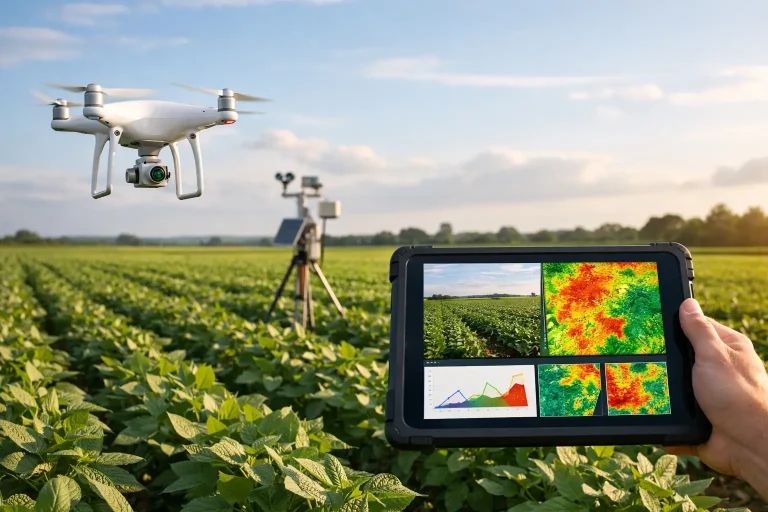
A healthy crop reflects and absorbs light differently from a stressed one. Multispectral sensors capture data in selected bands, typically including visible light and near-infrared, which are then used to build vegetation indices such as NDVI and related plant health layers. These outputs do not tell you everything on their own, but they do reveal patterns that standard scouting and conventional aerial photography can miss.
That distinction is important. A normal RGB image can show obvious bare ground, standing water or lodging, but it is less effective when the problem is subtle and developing. Multispectral data can highlight reduced vigour earlier, helping you focus field inspections, tissue testing or input changes where they are likely to have the greatest return.
In practical terms, higher yields often come from making fewer broad assumptions. Instead of treating an entire field as uniform, multispectral monitoring shows where performance is diverging. That allows more targeted irrigation decisions, more accurate fertiliser strategy and faster intervention when disease, drainage or compaction starts to affect plant growth.
How to increase crop yields with multispectral monitoring
The strongest results come when multispectral monitoring is used as a decision tool rather than a visual extra. The data should guide action, not sit in a report and be admired for its colour scale.
The first benefit is earlier detection of stress. Crops under pressure from poor drainage, inconsistent irrigation, nutrient shortage or root-zone issues often show a shift in spectral response before the canopy looks visibly weak. That gives you a narrower, more manageable inspection area. Instead of walking every acre with the same level of attention, you can send your agronomist or team to the zones that need investigation first.
The second benefit is precision in variable fields. Few commercial sites are as even as they appear on paper. Soil texture changes, elevation changes, shaded margins, blocked outfalls and historic ground disturbance all affect performance. Multispectral maps show how these factors are expressing themselves through the crop. Once those patterns are clear, you can start matching management decisions to actual field conditions rather than averages.
The third benefit is measuring response over time. If you correct a drainage issue, adjust irrigation scheduling or alter a nutrition plan, multispectral monitoring gives you a repeatable way to see whether crop vigour improves. That matters because good land management is not only about finding problems. It is about proving whether the remedy worked.
What multispectral data can reveal
The most useful outputs are rarely dramatic. Often, they confirm where a field is underperforming and help explain why. Repeated low-vigour zones may point towards chronic compaction, poor infiltration or infrastructure issues. Irregular stress patterns may suggest irrigation inconsistency. Linear or mechanical patterns can indicate machinery impact or blocked systems. Localised hotspots may warrant disease inspection.
This is where aerial monitoring becomes commercially valuable. It compresses a large site into one coherent view. Patterns that are difficult to recognise at ground level become clear when seen spatially. For managers responsible for large acreages, estates or specialist turf, that overview can save considerable time and reduce guesswork.
There is a limit, though. Multispectral monitoring does not diagnose every issue automatically. A low index score means the crop is underperforming relative to surrounding areas, not that one single cause is confirmed. You still need ground truthing, agronomic judgement and, in some cases, soil or tissue analysis. The strength of the method is that it tells you where to look and where action is most likely to pay off.
Timing matters more than many realise
One flight at the right moment can be useful. A planned monitoring programme is usually far more valuable. Crops change quickly, and the significance of a stress signal depends heavily on growth stage, weather pattern and field history.
Early-season monitoring can help identify emergence issues, wet areas and establishment variability. Mid-season surveys are often where vigour mapping becomes most useful for identifying irrigation problems, nutrient shortfalls and crop stress before visible decline spreads. Later in the season, data can support harvest planning, remediation decisions and next-season strategy by showing where persistent variability affected performance.
The right schedule depends on the crop, the objective and the practical realities of the site. There is no universal rule. For some operations, a handful of well-timed surveys may be enough. For others, particularly where irrigation, drainage and input costs are significant, more regular monitoring can deliver stronger value.
Multispectral monitoring and irrigation performance
For irrigated land, one of the clearest uses of multispectral data is identifying inconsistency. Poor pressure, uneven coverage, blocked heads, leaks or ineffective scheduling do not always present as obvious visual symptoms straight away. Yet the crop often responds before the problem is clear from ground observation alone.
When low-vigour areas align with irrigation infrastructure or known hydraulic weak points, the data becomes highly actionable. You are no longer relying only on anecdotal observations such as dry patches or variable colour. You can compare zones spatially and investigate with purpose. That leads to better maintenance decisions and more efficient use of water, which matters both commercially and operationally.
This is especially relevant for managers already used to precision mapping in other parts of site maintenance. Aerial intelligence is at its best when it fits into existing workflows rather than becoming a separate exercise.
Why drone-based delivery adds practical value
The quality of the decision depends on the quality of the data. Drone-based multispectral monitoring offers high-resolution, site-specific outputs collected when conditions on the ground require attention. That flexibility is important. Satellite imagery has a place, but resolution, cloud cover and timing can limit usefulness when you need a clear, current view of a specific problem area.
A professional drone survey also gives you more than a generic image. Accurate flight planning, calibrated sensors and reliable processing are what turn raw capture into dependable management data. For commercial users, that distinction matters. If the mapping is inconsistent or poorly aligned, confidence in the decisions that follow drops quickly.
This is where a specialist provider can make a measurable difference. Vantage Imagery Limited approaches multispectral work as part of a wider precision mapping service, with the emphasis on actionable outputs rather than attractive visuals. For land managers making operational decisions, that is the standard that matters.
Common mistakes that reduce the value of monitoring
The biggest mistake is treating multispectral imagery as an answer in itself. It is not. It is a high-value layer of evidence that becomes powerful when combined with site knowledge, field checks and a clear management objective.
Another common issue is poor timing. A survey taken too late may confirm what is already obvious. A survey taken without regard to growth stage or recent weather can also be harder to interpret. Then there is overreaction. Not every variation needs immediate intervention. Some areas will naturally perform differently because of soil, aspect or long-term field characteristics. The goal is not to erase all variability. It is to understand which variability is costing yield and which is simply part of the site.
Finally, there is the question of scale. If your workflow cannot act on the data, the benefit is reduced. The best monitoring plans are built around realistic decisions – where to inspect, what to test, what to adjust and how to measure improvement.
A more precise route to better yields
To increase crop yields with multispectral monitoring, think less about technology for its own sake and more about earlier visibility, better targeting and stronger follow-through. Yield gains rarely come from one dramatic intervention. They usually come from reducing small, repeated losses across the season.
When you can see stress sooner, map variability properly and respond with confidence, management becomes more precise and more commercially effective. That is where multispectral monitoring earns its place – not as a novelty, but as a practical advantage for anyone responsible for crop performance.
