
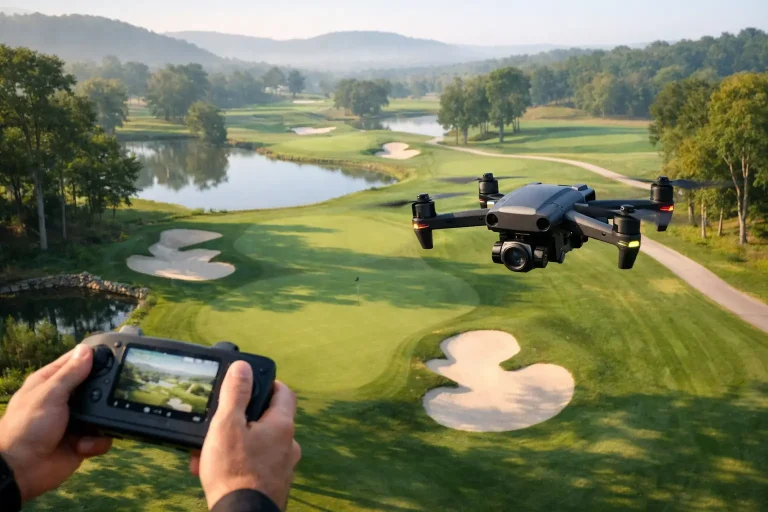
A bunker that keeps washing out, a wet fairway that never quite dries, an irrigation line nobody can trace with confidence – these are not design problems on paper. They are operational costs on the ground. That is exactly why do you need a golf course drone survey becomes such a practical question for clubs, course managers and consultants trying to make better decisions with less guesswork.
A golf course is a large, complex working environment. It includes playing surfaces, drainage networks, irrigation infrastructure, tree cover, paths, buildings, boundary features and constant maintenance demands. Managing all of that from outdated plans, fragmented records or basic aerial imagery is rarely enough. A professional drone survey gives you current, survey-grade data that can be used to understand the course properly and act on it with precision.
Why do you need a golf course drone survey for day-to-day management?
The short answer is that visibility changes decision-making. When you can see the course accurately from above, and when that imagery is tied to precise mapping data, routine management becomes more controlled.
For a course manager or head greenkeeper, that often means being able to spot patterns that are difficult to identify at ground level. Low-lying areas become clearer. Surface run-off routes are easier to understand. Wear lines around tees and approaches show up more plainly. Tree encroachment, shade pressure and problem rough can be assessed in context rather than as isolated issues.
This matters because golf course maintenance is rarely about one feature in isolation. A soft green approach might be related to drainage, but it could also be linked to surrounding contours, compacted routes for machinery or overspray from irrigation. Drone survey data helps connect those factors.
Just as importantly, it creates a reliable baseline. Once you have an accurate digital record of the course, future changes can be measured against something dependable rather than memory, assumption or old contractor drawings.
Better drainage decisions start with better data
Drainage is one of the clearest reasons to invest in a drone survey. Water management affects playability, presentation, labour demands and long-term turf performance. Yet many clubs still address drainage reactively, treating symptoms rather than understanding the wider hydrology of the site.
A drone survey can produce detailed topographical mapping with centimetre accuracy. That gives you a far clearer picture of gradients, fall lines and local depressions across fairways, surrounds and rough. It becomes easier to identify where water is likely to collect, how it moves after heavy rain and which areas are repeatedly under pressure.
This is where aerial data moves beyond photography. A proper survey is not simply about looking at the course from above. It is about extracting measurable terrain information that supports drainage planning, trench routing, outfall design and contractor briefing.
There is a clear commercial advantage here. If you are planning drainage works, the cost of getting the diagnosis wrong is usually far higher than the cost of accurate survey data. The same applies if you are prioritising one part of the course over another. With strong topographical information, you can target spend where it will have the greatest operational impact.
Irrigation mapping is easier when assets are visible
Many golf clubs are working with irrigation systems that have evolved over decades. Drawings may be incomplete, inaccurate or missing entirely. Control boxes, valve positions, main lines and lateral runs are not always recorded in a format that helps the team on site.
A golf course drone survey can support irrigation mapping by providing a precise visual framework for the whole system. Once aerial mapping is aligned with known infrastructure and utility information, it becomes much easier to understand where assets sit in relation to greens, fairways, paths and landscape features.
That has practical value every time maintenance, repairs or upgrades are being discussed. It can reduce unnecessary excavation, improve communication with contractors and help avoid delays caused by uncertainty. If you are planning a phased irrigation upgrade, accurate mapping also gives consultants and installers a more reliable basis for design.
The trade-off is that drone data is strongest when paired with good ground truthing and existing records. It will not magically reveal every buried pipe without supporting inputs. What it does do exceptionally well is create the accurate site model that allows those inputs to be organised and used properly.
Why do you need a golf course drone survey for project planning?
Any course improvement project benefits from a better starting point. That includes bunker renovations, tee extensions, path works, drainage schemes, woodland management, practice area development and wider course redesign.
Without a current survey, project teams often rely on a patchwork of assumptions. Dimensions may be estimated. Levels may be checked only in isolated locations. Existing features may be recorded inconsistently. That slows design work and increases the risk of avoidable changes once the job starts.
Drone surveying gives architects, consultants and contractors a faster route to understanding the site in detail. Orthomosaics, topographical models and surface mapping can be used to assess options, plan logistics and define extents more accurately. It is especially useful on golf courses because of their scale. Walking and conventionally measuring every relevant area takes time, and by the time that process is complete, conditions may already have shifted.
This does not mean drone surveys replace every traditional surveying method. On projects requiring legal boundary definition, underground detection or highly specific engineering checks, additional specialist surveys may still be needed. But as a foundation for planning and coordination, drone data is often faster, clearer and more cost-effective.
Turf health and stress become easier to monitor
Not every issue on a course starts with obvious physical damage. Turf stress often develops gradually, influenced by moisture imbalance, compaction, disease pressure, nutrient variability or shade. By the time symptoms are visible from the ground, the underlying problem may already be established.
This is where drone survey capability can extend beyond mapping. Multispectral analysis allows turf managers to identify variation in plant health across large areas with far more consistency than visual checks alone. Greens, fairways and approaches can be assessed in a way that highlights stressed zones before they become more expensive to rectify.
For clubs trying to manage inputs carefully, that is valuable. Rather than applying the same response everywhere, teams can focus attention where it is genuinely required. That can support more efficient use of water, fertiliser and labour while improving presentation and playability.
It also helps with reporting. If you need to explain recurring turf issues to a committee, owner or consultant, mapped evidence is much stronger than anecdotal description.
A drone survey improves communication across the business
One of the less obvious benefits of a golf course drone survey is clarity between stakeholders. Managers, greenkeeping teams, consultants, architects and committees do not always look at a problem in the same way. Ground-level discussion can become subjective very quickly.
Accurate aerial mapping changes that. It gives everyone a common visual reference and, when produced to the right standard, a shared set of measurements. That can make planning meetings more productive and reduce friction around priorities, budgets and timing.
It also supports documentation. If you are tendering works, applying for investment approval or building a phased maintenance plan, good survey outputs present the course professionally and credibly. For many clubs, that alone improves internal decision-making.
Speed matters, but accuracy matters more
There is a reason specialist surveying providers stand apart from generic drone operators. On a golf course, the value does not come from simply flying over the site and producing attractive imagery. It comes from collecting data correctly, processing it to a high standard and delivering outputs that can actually be used in course management and project workflows.
That is why certified operations, advanced mapping methods and sector knowledge matter. A provider that understands golf infrastructure, playing surfaces and maintenance realities will capture the data with a different purpose in mind.
Vantage Imagery Limited works in that specialist space, focusing on precision-led drone surveys and mapping that support operational decisions rather than creating generic visuals. For clubs that need more than photographs, that difference is significant.
When is the right time to commission a survey?
Usually earlier than you think. The best time is before uncertainty starts costing money. That might be ahead of winter drainage works, before an irrigation redesign, during budgeting for course improvements or when recurring surface problems no longer have a clear explanation.
It is also worth commissioning a survey after major works are complete. Post-project mapping gives you a valuable record of what changed and a stronger basis for future maintenance planning.
If your current plans are outdated, if your team is relying on memory to locate assets, or if project discussions keep circling around incomplete information, a drone survey is no longer a nice extra. It is a practical management tool.
The strongest courses are not just maintained well. They are understood well. Accurate aerial survey data gives you that understanding, and once you have it, decisions become sharper, budgets work harder and the course becomes easier to manage with confidence.
