 Skip to main content
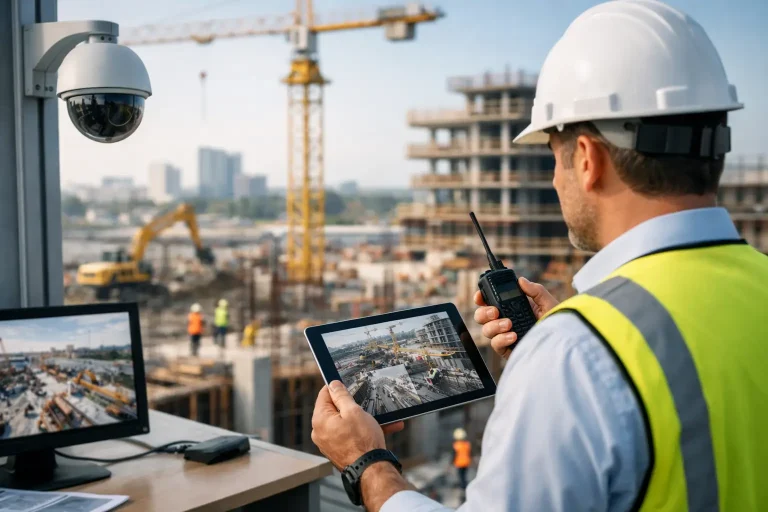
When a site starts moving quickly, small gaps in visibility become expensive. A missed drainage issue, an earthworks variance or a delay hidden behind fragmented reporting can knock confidence in the programme and force reactive decisions. That is why construction monitoring matters – not as a box-ticking exercise, but as a practical way to keep projects controlled, measurable and easier to manage.
For contractors, developers, consultants and facilities teams, the value is straightforward. You need current, accurate information on what is happening across the site, not just what was planned on paper or reported at the last meeting. Good monitoring turns progress into something you can see, measure and verify.
What construction monitoring actually means
Construction monitoring is the ongoing observation and recording of site conditions, project progress and physical change over time. In practice, that can include regular aerial surveys, topographical updates, photographic records, volumetric calculations, orthomosaics, 3D models and condition checks for specific assets or structures.
The key point is consistency. A single survey is useful, but monitoring is valuable because it creates a time-based record. That record allows teams to compare one stage against another, check progress against programme expectations and identify issues before they become larger commercial or operational problems.
This is particularly relevant on sites with significant ground movement, phased works, utility coordination or multiple stakeholders. If several parties are making decisions from different versions of the truth, delays and disputes become more likely. Reliable monitoring reduces that risk.
Why traditional progress reporting often falls short
Most projects already have reporting systems. Site walks, contractor updates, progress photographs and consultant reviews all have their place. The problem is that they are often partial. They may depend on where someone happened to stand, what they chose to photograph or how recently the information was captured.
That does not make traditional reporting redundant. It means it works best when supported by objective site data. Aerial construction monitoring adds a wider, more precise view of the whole project. Instead of relying only on narrative updates, teams can assess visible progress across access routes, stockpiles, drainage works, roof areas, façade installation or earthworks zones with much greater clarity.
There is also a speed advantage. Large or awkward sites take time to inspect from the ground, especially when access is restricted or active operations limit movement. Drone-based monitoring can capture broad site coverage quickly while producing outputs that are much easier to review and share.
Where aerial construction monitoring delivers the most value
The strongest use cases tend to be the ones where scale, complexity or change create uncertainty. Earthworks projects are a good example because progress is not always easy to judge visually from the ground. Cut and fill volumes, formation levels and stockpile changes can all be measured more confidently when repeatable aerial data is available.
It is equally useful on commercial developments where stakeholders need regular visibility without attending the site in person. Developers, project managers and clients can review progress against milestones using current imagery and mapped outputs rather than waiting for fragmented updates.
For roof works, façade repairs and estate improvements, monitoring also improves safety and access. Rather than relying on repeated manual inspections, teams can capture high-resolution imagery from above and review details in a controlled way. That is often quicker, less disruptive and more efficient, though the right method will still depend on the structure, site constraints and the inspection objective.
Precision matters more than pretty pictures
A common mistake is to treat aerial monitoring as little more than visual marketing content. Good site imagery can certainly help with communication, but operational value comes from accuracy. If the data is not reliable enough to support planning, measurement and verification, it is only a visual record.
That is where survey-grade outputs make the difference. Centimetre-level mapping, properly processed orthomosaics and accurate surface models give project teams something they can work with. You are not just looking at the site – you are using data to check dimensions, monitor change and support decision-making.
This distinction matters when timelines are tight. If a contractor needs to understand whether an area is ready for the next phase, or whether materials are being stored as planned, measurement-backed imagery is far more useful than general photography. The same applies when tracking drainage channels, access roads or site compound changes across a programme.
Construction monitoring and accountability
Projects rarely suffer from too much clarity. More often, the problem is uncertainty around who knew what and when. A structured monitoring programme creates a dated, repeatable record that helps reduce ambiguity.
That can support internal management, but it also has value in client reporting and contractor coordination. If progress is slower than expected, or if completed works do not align with what was anticipated, a reliable visual timeline gives everyone a stronger basis for discussion. It does not remove commercial tension, but it does improve the quality of evidence.
There is a practical balance to strike here. Monitoring should not become excessive or generate data that nobody reviews. The right frequency depends on the pace of works, the stage of the project and the decisions being made from the outputs. Weekly captures may be right for fast-moving sites, while monthly updates may be more sensible for longer phases with less visible change.
What project teams should look for in a monitoring service
Not every provider approaches construction monitoring with the same level of technical rigour. For commercial use, image quality alone is not enough. The process needs to be dependable, repeatable and designed around operational outcomes.
Start with accuracy and consistency. Captures should be planned in a way that allows comparison over time, using repeatable flight paths or survey methodology where appropriate. That consistency is what makes trend analysis and progress verification meaningful.
It is also worth looking at the outputs, not just the flight itself. The real question is what the project team receives and whether it can be used easily. Progress imagery, orthomosaics, 3D models, contour data, stockpile volumes and annotated reports all serve different purposes. The best approach depends on the site and the reporting requirement.
Then there is interpretation. Data has more value when it is delivered in a form that helps teams act on it. A specialist provider should be able to explain what is changing on site, where attention may be needed and how the information can fit into wider planning or asset workflows.
The trade-offs to understand
Construction monitoring is highly effective, but it is not a substitute for every survey or inspection method. Dense vegetation, covered structures, interior works and some technical compliance checks will still require ground-based input or other specialist surveys. Weather, airspace restrictions and site safety constraints can also affect capture windows.
That is not a weakness so much as a planning consideration. The best results come when monitoring is integrated sensibly with the wider project process. Aerial data provides scale, frequency and visibility. Ground teams provide detail, validation and context. Used together, they create a much stronger picture of project status.
There is also a commercial judgement to make. Some projects need highly frequent monitoring because the cost of poor visibility is high. Others only need milestone-based capture. The point is to match the service to the decision-making value, not to collect data for its own sake.
A smarter way to stay ahead of the site
Well-executed construction monitoring gives teams more than a record of what happened. It provides earlier warning of issues, stronger evidence for reporting and a clearer understanding of how a site is actually evolving. That improves control, especially when multiple contractors, deadlines and technical dependencies are in play.
For clients who need accurate aerial data rather than generic drone footage, that difference is significant. Precision-led providers such as Vantage Imagery Limited focus on outputs that support real project decisions, whether the requirement is progress tracking, topographical context, volume measurement or ongoing asset visibility.
If a project is valuable enough to monitor, it is valuable enough to monitor properly. The best time to improve visibility is before uncertainty starts costing money.
