 Skip to main content
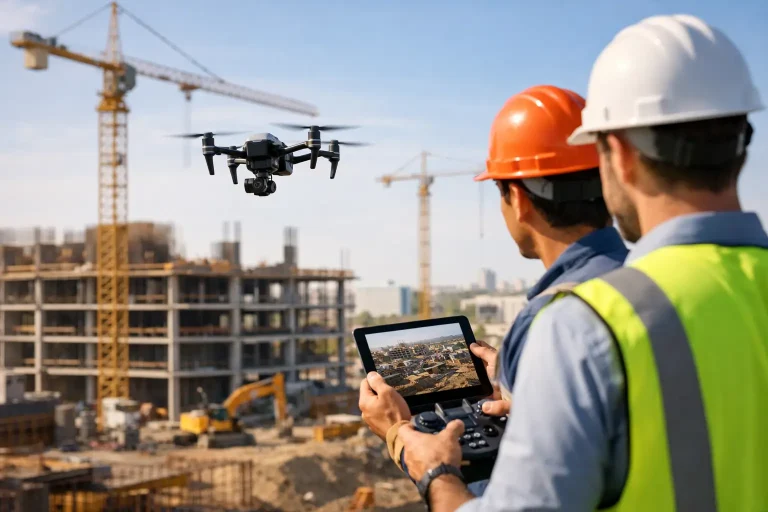
A project can look on programme in the site office and tell a very different story from above. Haul roads shift, stockpiles grow, drainage falls behind, and trade clashes appear long before they reach the progress report. That is where construction site drone monitoring proves its value – not as marketing footage, but as a precise, repeatable way to see what is actually happening across the whole site.
For contractors, developers and project managers, the attraction is simple. Better visibility leads to better decisions. A drone survey can capture current conditions quickly, safely and with a level of detail that supports planning, reporting and accountability. When that data is collected consistently, it becomes far more than imagery. It becomes a record of progress, a source of measurable site intelligence and, in many cases, a practical way to reduce delays and avoid expensive rework.
What construction site drone monitoring actually means
Construction site drone monitoring is the regular capture of aerial data over an active site to track change over time. That may include orthomosaic maps, topographical outputs, 3D models, volumetric measurements, progress imagery and inspection visuals. The key point is consistency. One flight is useful. A planned sequence of flights, captured to the same standard, gives decision-makers a reliable baseline and a clear view of movement, progress and risk.
This is why the strongest drone monitoring programmes are built around operational needs rather than generic photography. A site manager may need weekly progress mapping for subcontractor coordination. A developer may want monthly reporting for stakeholders and funders. A commercial team may need accurate stockpile volumes. An engineer may need to compare earthworks against design intent. The data should match the job it needs to do.
Why aerial monitoring is now part of serious site management
Traditional site reporting still matters, but it has limits. Ground-level photos are selective. Manual notes depend on who collected them and what they noticed at the time. Walkovers take time and can miss broader spatial issues. Drone data fills that gap by providing a complete visual layer across the site, captured in a fraction of the time required for extensive manual inspection.
There is also a safety advantage. Not every area should be inspected on foot, particularly during heavy plant movement, unstable ground conditions or early-stage works. Aerial capture reduces unnecessary exposure while still giving teams the information they need. That matters on busy sites where access windows are tight and operational disruption needs to be kept to a minimum.
The real value, though, is not the flight itself. It is what the output allows teams to do afterwards. They can verify progress, identify change, compare planned and actual conditions, communicate clearly with stakeholders and maintain an evidence base throughout the build. That level of clarity is difficult to achieve with fragmented photos and occasional survey visits alone.
The most useful outputs from construction site drone monitoring
Not all drone deliverables have the same purpose, and this is where many buyers need clear advice. If the goal is visual reporting, then high-resolution progress imagery may be enough. If the goal is planning and measurement, survey-grade mapping is the priority.
Orthomosaics are especially useful because they create a current, scaled overhead map of the site. Teams can review access routes, storage areas, material distribution and work zones with far greater clarity than standard site photos allow. When those maps are refreshed regularly, change becomes easy to track.
Topographical mapping adds another level of value. On projects involving cut and fill, drainage, retaining structures or platform preparation, terrain data can support both progress checks and decision-making. Volumetric analysis is similarly valuable where stockpiles, spoil movement or aggregate management need to be measured rather than estimated.
3D models can help communicate complex site conditions to clients, consultants and off-site stakeholders. They are not always necessary, but on larger or more technically demanding projects they can improve coordination and reduce misunderstanding. The best approach depends on project stage, site complexity and the decisions the data needs to support.
Where drone monitoring delivers the strongest commercial return
The strongest return usually comes from avoiding blind spots. Small issues are cheaper to correct when they are found early. If drainage runs are not progressing as expected, if temporary works are affecting access, or if earthworks are drifting away from plan, a timely aerial record can bring that to light before the problem compounds.
It also improves reporting discipline. Investors, clients and senior teams often want clear evidence that work is progressing in line with programme. Drone monitoring creates a consistent and objective record. That makes reporting more credible and often reduces the back-and-forth that comes with unclear updates or incomplete photographic evidence.
On some sites, the commercial benefit is direct. Measured stockpile volumes, verified progress areas and accurate records of site conditions can support valuations, interim applications and dispute avoidance. On others, the benefit is operational – fewer surprises, better sequencing and stronger communication between office and site teams. It depends on the project, but the value is usually clearest when the data is tied to a specific management process.
What good construction site drone monitoring looks like
Quality starts with repeatability. Flights should follow a consistent method, with appropriate overlap, suitable altitude, reliable control and outputs processed to a professional standard. Without that discipline, comparisons over time become less meaningful and measurement confidence starts to fall away.
It also depends on the operator understanding construction, not just drones. A technically competent flight is only part of the job. The more important question is whether the provider knows what to capture, what outputs matter, and how those outputs will be used by project teams. Construction managers do not need a gallery of dramatic angles. They need usable information.
This is why specialist providers stand apart from generalist aerial media operators. Survey-grade workflows, accurate ground control, structured reporting and practical deliverables matter far more than flashy footage. At Vantage Imagery Limited, that principle runs through every data-led project – precision first, then outputs tailored to operational use.
The trade-offs buyers should understand
Drone monitoring is highly effective, but it is not a replacement for every survey or every site visit. Weather can affect scheduling, especially in exposed locations. Dense urban environments, restricted airspace or complex operational constraints may require additional planning. There are also times when terrestrial survey methods remain necessary for specific technical detail or under-canopy areas.
Frequency is another judgement call. Weekly capture can be excellent on fast-moving projects, but it may be unnecessary on slower programmes. Monthly monitoring may suit one site perfectly and leave another with too many gaps. The right schedule depends on rate of change, reporting requirements and budget.
Accuracy should be considered carefully as well. If a client needs visual progress records, that requirement is very different from needing centimetre-level mapping for earthworks or setting-out verification. The output specification should be agreed at the start so the data delivered is fit for purpose rather than broadly impressive but commercially vague.
How to choose a drone monitoring provider
The best question is not whether a provider can fly, but whether they can deliver dependable site intelligence. Ask what outputs are included, how accuracy is controlled, how repeat visits are standardised and how the results will be presented to your team. If they cannot explain that clearly, they are probably selling imagery rather than monitoring.
It is also worth looking at how consultative the service is. Strong providers will ask about project stage, measurement requirements, reporting workflows and stakeholder needs. They will recommend a capture schedule based on actual use rather than offering the same package to every client.
Certification, planning discipline and operational safety should be assumed, but not taken for granted. Construction environments demand a professional standard of flight operations and risk management. A credible provider should be able to work within live site constraints without creating disruption or uncertainty.
A better way to see the job as it really is
Construction teams rarely struggle because they have too much clarity. More often, problems grow in the gaps between what is assumed, what is reported and what is actually happening on the ground. Construction site drone monitoring closes those gaps with current, accurate and usable aerial data.
When it is done properly, it becomes part of how a site is managed rather than an occasional add-on. You get progress visibility that can be trusted, mapping that supports decisions, and a clearer basis for planning the next phase of work. For any project where timing, coordination and accountability matter, that is a very practical advantage.
