 Skip to main content
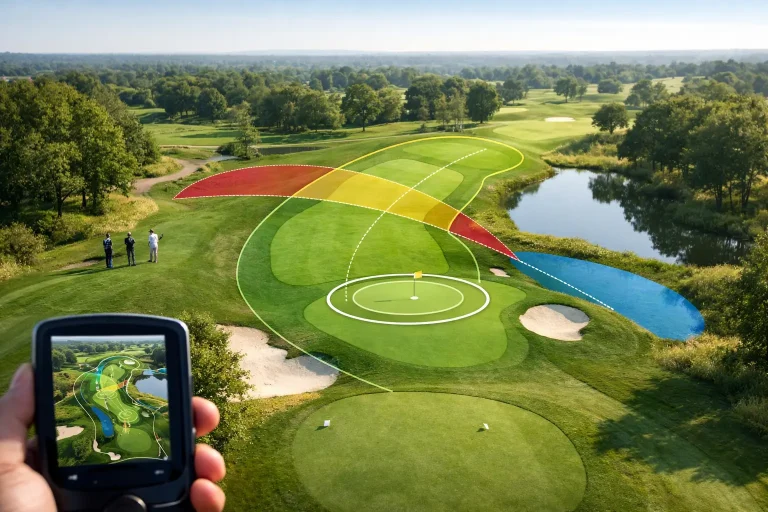
If you have ever tried to answer a simple question such as “where exactly does that lateral run?” and ended up with three paper plans, a faded CAD file and a lot of guesswork, you already know why a golf course overlay guide matters. On a modern course, decisions about irrigation, drainage, turf health, utilities and project works all rely on one thing – being able to see the right information in the right place.
A golf course overlay is not just an aerial image with a few lines drawn on top. Done properly, it is a layered visual dataset built on accurate survey control, so operational teams can compare physical features, underground infrastructure and management zones against real-world positions. That difference is what turns imagery into a working tool rather than a nice picture for a committee meeting.
What a golf course overlay guide should actually cover
The useful version of a golf course overlay guide starts with purpose, not software. Before anyone discusses file types or display settings, the key question is what the course needs to manage more effectively. For one site, that may be irrigation troubleshooting. For another, it may be drainage planning, bunker refurbishment, tree management or utility awareness before contractor works begin.
The strongest overlays usually combine a recent orthomosaic base map with selected operational layers. Those layers might include irrigation heads and pipe routes, valve boxes, control wiring, drainage runs, outfalls, wet areas, cart paths, sprinkler arcs, hazard extents, hole-by-hole management zones or measured green and bunker edges. When the base imagery is survey-grade and the overlay positions are properly checked, teams can trust what they are seeing.
That trust is the real value. If the underlying image is only approximately aligned, small errors quickly become expensive ones. A valve shown one metre out may still look acceptable on screen, but on the ground it wastes labour, delays repairs and can lead to poor decisions during planned works.
Why overlays are now central to course management
Golf course management has become more data-driven, but many sites still work with fragmented records. The irrigation plan may sit with one contractor, drainage notes may live in a superintendent’s memory, and utility information may be incomplete or buried in archived drawings. An accurate overlay brings those strands together in one usable view.
For club managers, that means clearer visibility when budgeting or phasing capital projects. For course managers and greenkeeping teams, it means fewer assumptions during maintenance and faster problem diagnosis. For architects and consultants, it means better context when reviewing strategy, redesign options or surface-performance issues.
There is also a practical communication benefit. Aerial overlays make technical information easier to explain to committees, contractors and stakeholders who may not read engineering drawings comfortably. When drainage failures, irrigation constraints or worn traffic lines are visible against current aerial mapping, conversations become more precise and less subjective.
The layers that usually deliver the most value
Not every golf course needs every possible overlay. In practice, the most valuable layers are the ones linked to repeat costs, recurring faults or future works.
Irrigation overlays
These are often the first priority because irrigation infrastructure is expensive, buried and business-critical. A proper irrigation overlay may include sprinkler locations, pipe routes, main lines, laterals, valves, decoder positions, tanks, pump stations and control references. If integrated cleanly, it becomes far easier to diagnose dry spots, isolate faults and plan upgrades.
There is a trade-off here. Historic irrigation plans are often incomplete, and some courses have decades of alterations that were never fully recorded. In those cases, the overlay should be treated as a living operational map that improves over time, not a fixed document pretending to be perfect from day one.
Drainage overlays
Drainage issues are rarely random. They tend to follow patterns linked to fall, soil profile, outlet performance and historic installation work. When drainage runs, outfalls, wet zones and low-lying areas are shown together over accurate aerial mapping, the causes of recurring waterlogging become easier to interpret.
This is especially useful when planning winter works or prioritising investment. Instead of reacting hole by hole, clubs can assess drainage performance across the site and focus spend where it will have measurable operational impact.
Utility and infrastructure overlays
Utility overlays matter whenever excavation, construction or refurbishment is planned. Power, water, communications and service routes are easy to underestimate until a contractor hits something costly. Overlaying known services, tracks, compound areas, buildings and access routes creates a more complete operational picture.
Turf and vegetation health overlays
Multispectral data adds another dimension. Rather than only showing where features are, it can help indicate where turf is under stress, where irrigation distribution may be uneven, or where localised problems are developing before they become visually obvious from ground level. These overlays are not a replacement for agronomic judgement, but they are an excellent decision-support tool.
Accuracy is what separates a useful overlay from a risky one
This is where many projects go wrong. Courses often have access to aerial photos from consumer drones or online mapping platforms, but those images are not necessarily precise enough for technical overlay work. If you want to use overlays for planning, locating assets or integrating with management workflows, accuracy matters.
Survey-grade drone mapping uses controlled capture methods, calibrated processing and proper ground referencing to produce reliable outputs. For golf courses, that means orthomosaics and models aligned closely enough to support genuine operational use. Centimetre-level accuracy is not marketing language in this context – it is the threshold that makes overlay data dependable when money and labour are on the line.
It also affects long-term usability. A course that invests in accurate base mapping once can continue adding layers over time with far more confidence. If the base is weak, every new overlay inherits that uncertainty.
Building a golf course overlay guide into real workflow
The most successful overlay projects are designed around how the course team actually works. There is no point producing technically impressive data if nobody can use it easily during a repair call, a consultant visit or a planning meeting.
For some clients, that means clean PDF plans and annotated aerial sheets for quick reference. For others, it means digital files that can be used within irrigation software, CAD environments or GIS-style management systems. The right format depends on internal capability, available software and how often the data will be updated.
This is also why specialist golf experience matters. A mapping partner needs to understand not just how to capture drone data, but how a golf course operates. Greens, fairways, surrounds, practice areas, service corridors and legacy infrastructure all have different management implications. The overlay has to reflect that reality.
Vantage Imagery Limited approaches this work as a precision mapping exercise with an operational end use. That distinction matters because the output is built to support maintenance planning, infrastructure visibility and better day-to-day decision-making rather than simply producing aerial visuals.
Common mistakes to avoid
The first mistake is assuming any aerial image can support technical overlays. It cannot. If the image is not captured and processed for mapping accuracy, the overlay may look convincing while still being unreliable.
The second is trying to include every possible dataset at once. Overlays become cluttered very quickly. A better approach is to prioritise layers that solve immediate problems, then build the system gradually.
The third is treating legacy plans as fact. Older drawings are valuable, but they should be checked against current site conditions wherever possible. Golf courses evolve constantly, and undocumented changes are common.
The fourth is forgetting who needs to use the output. A consultant may want technical layers and coordinates. A greenkeeping team may need a clear operational view that works quickly on site. Good overlay design respects both.
When a golf course overlay guide delivers the biggest return
The return is usually strongest when a club is facing one of three situations. The first is repeated maintenance inefficiency – time lost locating infrastructure, diagnosing issues or briefing contractors. The second is planned capital work, where accurate visual context reduces risk and improves specification. The third is strategic review, where decision-makers need a more complete understanding of the course as a managed asset.
It is worth being honest about scale. A small overlay project focused on a few high-value layers can still produce a meaningful return. Not every club needs a fully integrated digital twin of the property. But almost every professionally managed course benefits from having at least one accurate aerial base and a set of priority operational overlays.
The courses that get the most from this approach tend to see overlays not as a one-off drawing package, but as infrastructure intelligence. Once that mindset shifts, the map becomes part of everyday management.
A good golf course overlay guide should leave you with one clear standard: if the data cannot help someone make a better decision on the ground, it is not finished yet.
