 Skip to main content
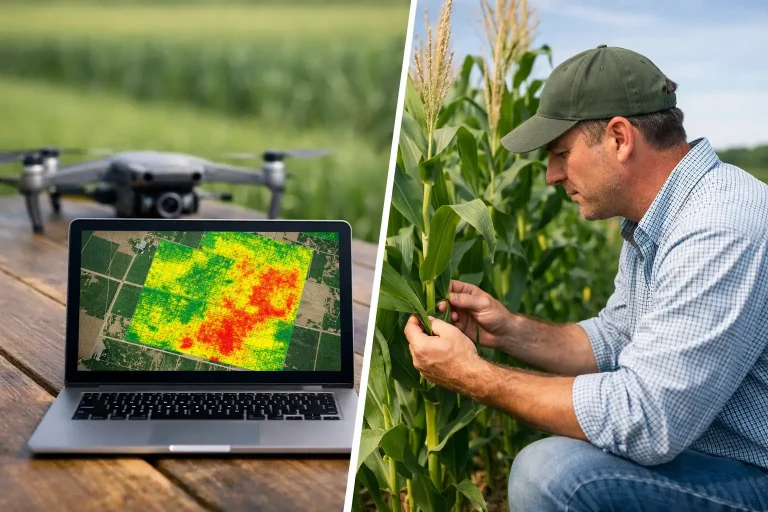
A green that looks fine from ground level can still be under pressure. By the time discolouration is obvious to the eye, the underlying issue may already be affecting playability, irrigation efficiency or turf recovery. That is where the debate around NDVI imagery vs visual inspection becomes genuinely useful – not as a choice between old and new, but as a question of which method gives you the earliest, clearest and most actionable picture.
For golf course managers, greenkeepers and turf professionals, this is not an academic comparison. It affects how quickly stress is identified, how accurately problem areas are defined, and how confidently maintenance budgets are directed. If your aim is precision rather than guesswork, both methods have value, but they do not deliver the same kind of intelligence.
NDVI imagery vs visual inspection – what is the real difference?
Visual inspection is exactly what most course teams have relied on for years. You walk the site, assess colour, density, moisture expression, disease symptoms, wear patterns and general turf performance, then make a judgement based on experience. On a well-run course, that expertise is critical. A skilled greenkeeper will often notice subtle change before a casual observer sees anything at all.
NDVI imagery works differently. It uses multispectral data to measure how vegetation reflects light, especially in the red and near-infrared bands. Healthy, actively photosynthesising turf reflects light differently from stressed turf. The result is a mapped index showing variation in plant vigour across the surface.
That distinction matters. Visual inspection tells you what the turf looks like. NDVI tells you how the turf is functioning. Those are not the same thing.
A surface can appear acceptably green but already be experiencing reduced vigour due to irrigation imbalance, compaction, drainage issues or early disease pressure. Equally, a patch that looks poor after wear or recent maintenance may not be as agronomically weak as it appears. NDVI adds a layer of measurable evidence that the eye alone cannot provide.
Where visual inspection still matters
There is no serious case for replacing experienced on-site assessment with imagery alone. Visual inspection remains essential because context matters. Turf management is full of variables that no index can interpret on its own.
A trained eye can spot signs that a sensor cannot fully explain in isolation – disease patterning, pest activity, recent mechanical damage, localised traffic stress, sand exposure, mower issues or the practical effect on ball roll and presentation. Visual inspection also allows for immediate tactile assessment. You can feel surface moisture, test firmness, inspect the rootzone and judge whether a visible problem is operationally urgent or simply cosmetic.
This is especially relevant on golf courses, where appearance and playing quality both carry weight. A fairway may show moderate stress in data terms but still perform well for the standard expected. Another area may look visually acceptable yet be heading towards failure under a dry spell. Ground truthing is what turns observations into decisions.
Visual inspection is also fast for obvious issues. If a bunker edge is collapsing, a drainage outfall is blocked or a worn approach is visibly thinning, you do not need NDVI to confirm that action is needed. In those cases, the value lies in practical judgement and timely response.
Where NDVI imagery has a clear advantage
The strongest case for NDVI is early detection and spatial clarity. It can reveal variation long before broad visual symptoms develop, and it does so across the whole site rather than just the areas someone happened to walk that morning.
That scale is one of its biggest operational strengths. A golf course is a large, complex environment with changing soils, microclimates, shade patterns, traffic routes and irrigation performance. Even a diligent inspection programme has limits. People are naturally drawn to known problem spots, and subtle shifts elsewhere can be missed until they become expensive.
NDVI imagery gives you a consistent, course-wide view. Instead of relying only on isolated observations, you can see patterns across greens, approaches, tees and fairways. Stress linked to irrigation coverage, poor drainage lines, compaction corridors or weak establishment often appears as a clear spatial pattern in the data. That makes diagnosis faster and more precise.
It also improves targeting. Rather than treating a broad area because it looks generally weak, teams can define the actual extent of the issue. That supports more efficient use of water, fertiliser, labour and renovation spend. In a commercial environment, precision matters because every unnecessary application and every delayed intervention has a cost.
NDVI imagery vs visual inspection for irrigation and drainage issues
This is one of the most useful comparisons in practice. Visual inspection can identify dry patch, pooling, runoff and inconsistent colour once those symptoms are visible. The challenge is that by that stage, turf stress is often already established.
NDVI imagery can help expose uneven performance earlier, particularly where irrigation uniformity is poor or drainage is influencing plant health beneath the surface expression. Repeated flights over time are especially valuable because they show whether a weak area is persistent, expanding or tied to weather events.
For example, if a fairway consistently shows lower vigour in the same corridor, the issue may not be generic drought stress. It could point to a blocked lateral drain, an irrigation coverage gap or a soil profile constraint. Visual inspection may confirm the symptom. NDVI helps define the pattern and support a more confident technical investigation.
For irrigation specialists and course managers, that is where the return lies. Better evidence leads to better diagnosis, and better diagnosis usually means less wasted spend.
The limitations of NDVI
NDVI is powerful, but it is not magic. Like any data source, it needs proper capture, interpretation and context.
First, NDVI does not tell you the cause of a problem on its own. It highlights where vegetation vigour differs, not why. Low values may result from drought stress, disease, shade, nutrient deficiency, wear, waterlogging or recent maintenance activity. Without supporting knowledge of the site, it is easy to overread the map.
Second, timing matters. Data collected immediately after aeration, topdressing or other disruptive work may reflect that activity rather than a developing agronomic issue. Weather conditions, seasonal growth stage and comparison date also affect interpretation. One image is useful. A reliable monitoring programme is far more valuable.
Third, not every visual issue will show as a meaningful NDVI anomaly. Purely cosmetic variation can look dramatic to the eye but have limited significance in plant performance terms. That is why NDVI should support management decisions, not dictate them in isolation.
The best answer is usually both
When clients ask whether NDVI imagery or visual inspection is better, the most accurate answer is that the strongest results come from combining them.
Visual inspection brings experience, context and practical judgement. NDVI adds consistency, measurable comparison and the ability to spot hidden variation at scale. Used together, they create a more complete decision-making process.
A sensible workflow often looks like this: multispectral imagery identifies unusual patterns or emerging stress, then the ground team investigates those zones directly. That investigation confirms the real cause, assesses severity and determines whether action is needed. Follow-up imaging can then measure whether the intervention worked.
This joined-up approach is particularly effective on high-value areas such as greens and approaches, where small performance losses can quickly affect presentation, playability and maintenance cost. It is also valuable for larger fairway systems, where walking every subtle variation regularly is difficult and inconsistent.
For specialist drone survey providers such as Vantage Imagery Limited, the real benefit is not simply producing attractive maps. It is delivering data that course teams can apply to irrigation planning, drainage assessment, turf health monitoring and long-term asset management.
Choosing the right method for your course
If your goal is immediate assessment of a visible problem, visual inspection is the starting point. If your goal is to detect stress earlier, monitor change over time or understand broad spatial patterns, NDVI offers a clear advantage.
If budgets are tight, the decision often depends on the cost of getting it wrong. On a golf course, delayed detection of turf stress can lead to lost quality, inefficient input use and more disruptive remedial work later. In that context, better data is not a luxury. It is a practical tool for protecting standards and controlling cost.
The most effective course teams do not choose between expertise on the ground and intelligence from the air. They use each where it performs best. If you want clearer evidence, earlier warning and more precise maintenance decisions, NDVI should not replace visual inspection. It should make it sharper.
