 Skip to main content
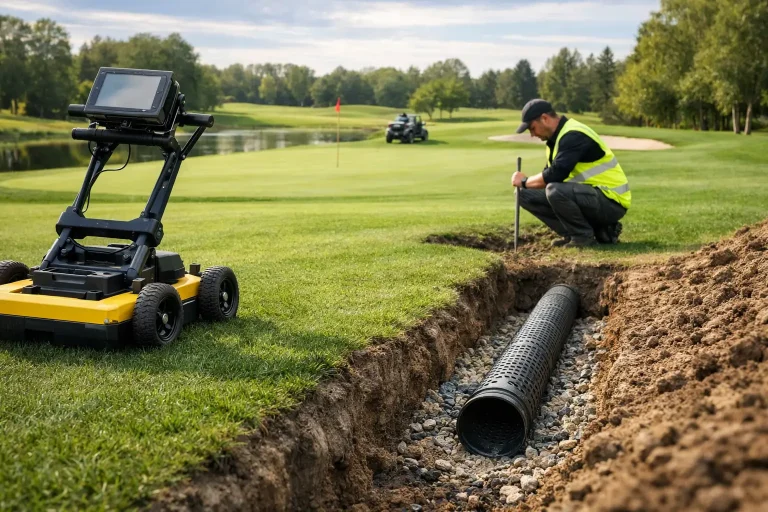
A fairway that looks playable at 8am can be soft, streaked and closing by noon after a modest spell of rain. For golf clubs, that gap between appearance and performance is where drainage problems become expensive. A fairway drainage survey UK courses can rely on is not simply about finding wet ground – it is about identifying why water is holding, where it is moving, and which intervention will improve year-round play without wasting budget.
Why fairway drainage problems are often misread
On many courses, drainage decisions start with visible symptoms. A weak strip in the landing area, tyre marking after routine maintenance, persistent winter softness, or turf thinning where water sits too long. Those signs matter, but they do not always point to the true cause.
Standing water may suggest blocked outfalls, yet the issue could be a subtle fall in levels that prevents water from moving freely. A fairway that plays wet every winter may appear to need wholesale drainage, but the real problem might be a limited number of failed lines, poor connectivity to collector drains, or localised compaction layered over an older system. Without a precise survey, clubs can end up treating symptoms instead of solving the drainage behaviour of the fairway itself.
That is why survey quality matters. Drainage design and remedial works depend on understanding levels, surface form, historic infrastructure and flow paths in context. Guesswork is rarely cheap once machinery is on site.
What a fairway drainage survey UK clubs actually need
A useful drainage survey is not just a set of aerial photographs and not just a basic topo. It should give course managers, consultants and contractors a practical basis for decision-making. That means accurate surface data, clear mapping of fairway shape and gradients, visible low points, catchment behaviour and, where possible, alignment with existing drainage and irrigation information.
For golf, detail is everything. A gentle hollow across a fairway can alter surface runoff. A slight shoulder can divert water towards a problem landing zone. A collector line that looks logical on an old plan may be offset from where it was actually installed. When the purpose of the survey is drainage planning, the outputs need to support real-world maintenance and project planning, not just produce an attractive map.
This is where drone-based surveying has changed the standard. With survey-grade data capture and photogrammetry, courses can assess larger areas quickly while still achieving the positional accuracy needed for engineering and maintenance decisions. Instead of isolated spot checks, you get a complete visual and topographical picture of how the fairway is behaving.
The value of high-accuracy surface mapping
Drainage starts with levels. If those levels are wrong, every decision that follows is weaker.
A high-accuracy fairway survey shows the subtle elevation changes that influence water movement across and along the playing surface. On golf land, those changes are often measured in centimetres, not metres. That is precisely why a drainage issue can remain stubbornly persistent even when the fairway looks broadly well-shaped to the eye.
Detailed topographical mapping helps teams answer practical questions. Where are the true low points? Is water trapped by cross-fall or unable to reach an outlet efficiently? Are there depressions that encourage ponding in key landing zones? Does the fairway shed water towards rough, paths or bunker edges, creating secondary maintenance problems elsewhere?
For clubs planning capital works, this level of detail reduces the risk of overdesign. Not every wet fairway needs a full reconstruction. In some cases, targeted interventions informed by precise mapping can produce a much better return than broader, more disruptive works.
Why aerial data is particularly effective on golf courses
Traditional ground methods still have a place, especially where detailed setting out or local verification is required. But fairways are broad, shaped spaces, and drainage problems rarely exist in isolation from the surrounding terrain. That makes aerial survey especially effective.
Drone capture allows large fairway corridors and adjoining features to be assessed as a connected drainage environment. You can see the relationships between tees, fairways, rough margins, paths, swales, ditches, ponds and outfall points rather than looking at each area separately. For course teams and consultants, that wider context is often what turns an uncertain diagnosis into a workable plan.
The other major advantage is speed. A modern aerial survey can gather extensive site data with minimal disruption to play and maintenance operations. That matters for busy clubs balancing member expectations, competition schedules and contractor access. Fast data capture does not mean sacrificing accuracy, provided the survey is undertaken with the right methodology and controls.
What the survey should reveal before any drainage work begins
Surface falls and local depressions
The most immediate requirement is understanding how water should move across the fairway surface and where that pattern breaks down. A proper survey highlights subtle basins, weak outfalls and areas where runoff is slowed or trapped.
Existing drainage infrastructure
If historical drainage plans exist, they should be reviewed alongside current survey data. Many clubs hold legacy records, but installed systems do not always match archived drawings perfectly. Overlaying known infrastructure with accurate mapping improves confidence before excavation starts.
Interaction with irrigation and utilities
Drainage planning cannot happen in isolation on a modern golf course. Irrigation lines, valve boxes, control systems and other buried services all affect where works can be carried out safely and efficiently. Integrated mapping reduces conflict and rework.
Wider site behaviour
A fairway may be suffering because it receives water from elsewhere. Adjacent slopes, paths, bunker overflows or compromised ditches can all contribute. Looking only at the visibly wet area can lead to a partial fix.
The trade-off between quick fixes and strategic drainage planning
Every course has budget realities. Sometimes the immediate need is to improve a narrow problem section before winter sets in. Sometimes the priority is building a phased programme across several holes. A fairway drainage survey supports both approaches, but the recommendations should reflect the club’s operational goals.
A localised scheme may be entirely sensible if the survey shows a contained issue with a clear outlet and limited upstream influence. Equally, that same scheme may disappoint if the fairway sits within a larger pattern of poor water movement across the hole. The right answer depends on whether the problem is isolated, repeated, seasonal or structural.
This is where precision data earns its value. It gives decision-makers a basis for prioritising. Instead of committing funds on instinct, clubs can compare urgency, likely benefit and project scope with far more confidence.
Using survey outputs beyond drainage alone
One of the strongest commercial arguments for accurate fairway mapping is that the data remains useful long after a drainage project is planned. The same survey can support course management in several adjacent areas.
Topographical information can feed into bunker redesign, path works, irrigation reviews and general course development. Orthomosaic imagery improves asset visibility and helps teams communicate planned works to committees and contractors. Where utility overlays are added, the survey becomes a far more valuable operational resource than a single-purpose drainage document.
For clubs trying to tighten maintenance planning and capital spend, that broader usability matters. Survey value is highest when it supports multiple decisions rather than sitting in a folder until the next wet winter.
Choosing the right survey partner
Not every drone operator is equipped to deliver drainage intelligence. There is a clear difference between promotional aerial imagery and survey-grade data capture intended to support technical decisions.
For a fairway drainage survey UK golf businesses should look for a provider that understands both the survey methodology and the practical realities of course management. Accuracy standards, processing capability, control methods and output formats all matter. So does sector knowledge. A specialist who understands how a fairway is built, maintained and played will usually ask better questions and produce more useful outputs.
This is particularly relevant where the survey needs to integrate with irrigation mapping, utility records or ongoing course improvement plans. The best results come from a consultative approach – not a generic flight and a folder of files, but actionable visual intelligence that can be used by managers, greenkeepers, architects and contractors alike.
Vantage Imagery Limited works in precisely that space, combining drone precision with practical golf course mapping outputs designed for maintenance planning and infrastructure decisions.
When to commission a fairway drainage survey
Timing depends on the objective. If the priority is diagnosing persistent wet areas, survey work is often most useful when issues are visible enough to confirm patterns but site access remains workable. If the goal is designing summer works, commissioning early gives clubs time to review options, cost projects and coordinate contractors.
There is also value in being proactive. Waiting until a fairway becomes unplayable narrows the club’s choices and often raises urgency-driven costs. A well-timed survey provides evidence before the problem reaches that point. It allows a measured response rather than a rushed one.
The strongest drainage decisions are rarely the most dramatic. They are the ones based on accurate terrain data, a clear view of existing infrastructure and a realistic understanding of how water behaves across the hole. When that information is in place, drainage work becomes more targeted, more defensible and far more likely to perform as intended.
If a fairway is repeatedly holding water, the first job is not to start digging. It is to see the ground properly.
