 Skip to main content
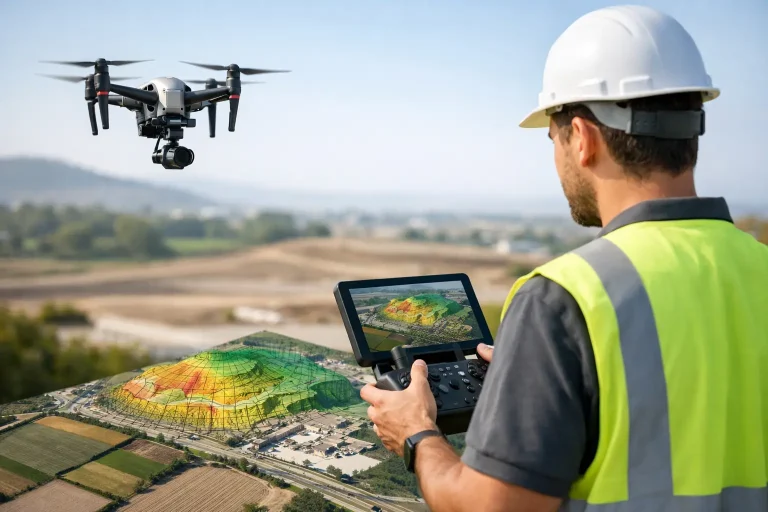
A map that is out by even a small margin can create expensive problems on the ground. On a golf course, that might mean drainage planned to the wrong fall, irrigation assets logged in the wrong place, or earthworks measured against an unreliable surface model. That is where cm accurate drone mapping matters – not as a marketing phrase, but as a practical standard for decisions that depend on precise location, elevation and distance.
For commercial land management, accuracy is not simply about producing a sharper image. It is about creating survey-grade data that can be trusted when teams are planning maintenance, reviewing infrastructure, pricing works or tracking change over time. If the outputs are not dependable, the map becomes decoration rather than a working asset.
What cm accurate drone mapping actually means
When people hear centimetre-accurate mapping, they often think of image quality first. In reality, the critical issue is positional accuracy. A drone survey can produce highly detailed imagery, but unless the data is properly georeferenced and processed, that detail does not automatically translate into reliable measurements.
Cm accurate drone mapping refers to aerial survey outputs that are tied to real-world coordinates with accuracy measured in centimetres rather than metres. That level of precision allows teams to use orthomosaics, surface models and topographical outputs with confidence for operational tasks, not just visual review.
How that accuracy is achieved depends on the survey method. It may involve RTK or PPK positioning, carefully planned flight paths, suitable control on the ground, and disciplined photogrammetry processing. The equipment matters, but the workflow matters just as much. Poor flight planning, inconsistent overlap, weak control or rushed processing can undermine a technically capable platform very quickly.
Why precision matters more on managed land
On complex sites, small errors do not stay small for long. Golf courses are a strong example because they combine shaped landscapes, buried services, drainage systems, irrigation networks, constructed features and intensively managed playing surfaces. A positional error of a few metres is not a tolerable inconvenience – it can affect maintenance planning, contractor instructions and capital works.
If you are reviewing drainage performance, you need confidence in elevation. If you are mapping sprinkler heads, valves or pipe runs, you need confidence in location. If you are planning bunker renovation, tee rebuilds or path works, you need a clean representation of the existing site before design decisions are made.
That is why high-accuracy mapping creates commercial value. It reduces uncertainty. It gives consultants, course managers and contractors a common reference point. It also improves repeatability, which is essential when comparing conditions across seasons or measuring the effect of completed works.
Where cm accurate drone mapping makes the biggest difference
The most obvious use is topographical mapping. Accurate drone surveys can generate detailed terrain information across large areas far faster than traditional methods alone. On a golf course, that helps with understanding levels, surface flow, low points, mounding, banks and shaped features that influence both playability and maintenance.
The second major application is infrastructure visibility. Irrigation and drainage networks are often managed through a mixture of drawings, local knowledge and partial records. Bringing those assets into an accurate aerial base plan makes the information more usable. It becomes easier to investigate recurring wet areas, plan trenching works, validate as-built layouts and coordinate future upgrades.
There is also value in project tracking. Construction and landscape changes can be recorded against a consistent spatial framework, allowing teams to compare surfaces, monitor progress and assess whether works are matching the intended design. That is relevant not only for golf but also for estates, developments and facilities where progress visibility affects cost and programme control.
For larger properties and commercial buildings, accurate drone mapping can support roof inspections, access planning and condition review. Here again, the practical gain is not simply seeing the asset from above. It is being able to measure, reference and communicate findings against dependable spatial data.
The difference between attractive imagery and usable survey data
A common issue in the market is the assumption that any drone operator can produce mapping that is suitable for decision-making. Many can capture impressive visuals. Far fewer can deliver data that stands up when measurements, overlays and operational planning are involved.
This distinction matters because buyers often discover the gap only after the work is done. A bright, detailed orthomosaic may look convincing, but if features do not align correctly, if levels are inconsistent, or if outputs cannot be integrated into existing CAD or GIS workflows, the apparent saving disappears.
Usable mapping starts with the end use. If the goal is promotional imagery, the tolerance is different. If the goal is to support irrigation design, drainage analysis or course redevelopment, the methodology needs to reflect that from the outset. The right provider asks what decisions the data needs to support before planning the mission.
What affects mapping accuracy in the field
No serious survey professional claims that accuracy comes from one piece of kit alone. It depends on a chain of decisions, and weakness at any point can compromise the result.
Site conditions play a part. Tree cover, complex terrain, reflective surfaces and poor GNSS reception can all affect data capture. Timing matters too. Low light, wind and surface movement can influence image quality and consistency. On active sites, access constraints and operational windows also shape the survey plan.
Then there is ground control and validation. In some scenarios, RTK or PPK workflows can achieve excellent results efficiently. In others, additional control and independent checks are the right approach. The best method depends on the site, the terrain and the level of confidence required.
Processing is equally important. Photogrammetry software can generate polished-looking outputs from mediocre inputs, which is why visual appearance alone is a poor benchmark. Accuracy is established through disciplined processing, quality checks and a clear understanding of coordinate systems, scale and error tolerance.
Why golf courses benefit especially from high-accuracy aerial mapping
Golf is one of the clearest examples of where precision and practicality need to work together. Course managers and greenkeeping teams are not looking for novelty. They need information they can use to maintain surfaces, trace infrastructure and plan improvements with minimal disruption.
An accurate aerial map gives the whole site context. Greens, tees, bunkers, fairways, paths, lakes, woodland edges and out-of-play areas can all be reviewed against one consistent spatial layer. That makes it easier to spot relationships that are difficult to read from ground level alone, particularly where drainage behaviour, shade pressure or traffic wear are involved.
It also improves communication. Consultants, architects, irrigation specialists and contractors can all work from the same reference data. That reduces ambiguity and shortens the gap between discussion and action. On complex projects, that clarity is often as valuable as the map itself.
For specialist providers such as Vantage Imagery Limited, the benefit is not merely flying a drone over a course. It is understanding what the client needs the data to do afterwards – whether that means integrating utility overlays, supporting maintenance strategy or creating a baseline for future works.
What to ask before commissioning cm accurate drone mapping
If you are comparing providers, the useful questions are straightforward. Ask what accuracy level is realistically achievable on your site and how it will be verified. Ask what outputs will be delivered and whether they are suitable for CAD, GIS or asset management use. Ask how the survey method changes if the site has tree cover, elevation change or difficult access.
It is also worth asking about the operational objective. A provider focused on business use should be able to explain how the mapping supports drainage planning, irrigation management, topographical understanding or project control – not just how long the drone will be in the air.
Price matters, of course, but so does downstream value. Cheaper data that cannot be relied upon is rarely cheap once teams start making decisions from it.
Precision is only valuable if it is usable
The real test of cm accurate drone mapping is simple. Does it help you make a better decision, faster, with less uncertainty? If the answer is yes, the survey has done its job. If the data sits in a folder because no one trusts it or knows how to use it, accuracy on paper means very little.
For golf courses, estates and commercial sites, the strongest aerial mapping projects are the ones that turn precision into action. Better visibility of levels, assets and site conditions leads to better planning. And better planning tends to show up exactly where it should – in time saved, cost avoided and work carried out with confidence.
