 Skip to main content
A bunker that never quite drains, a fairway that stays stressed through summer, a roof area no one has inspected properly for years – most site issues are not caused by a lack of effort. They are caused by incomplete visibility. A good aerial mapping guide starts there: not with the drone itself, but with the quality of decisions you need to make once you can finally see the whole site accurately.
For golf clubs, estates, contractors and facilities teams, aerial mapping is no longer just about attractive overhead imagery. Done properly, it produces survey-grade data that can support maintenance planning, drainage investigation, irrigation design, construction tracking and asset management. The difference between useful mapping and generic drone content comes down to accuracy, outputs and whether the information can be used in the real world.
What aerial mapping actually delivers
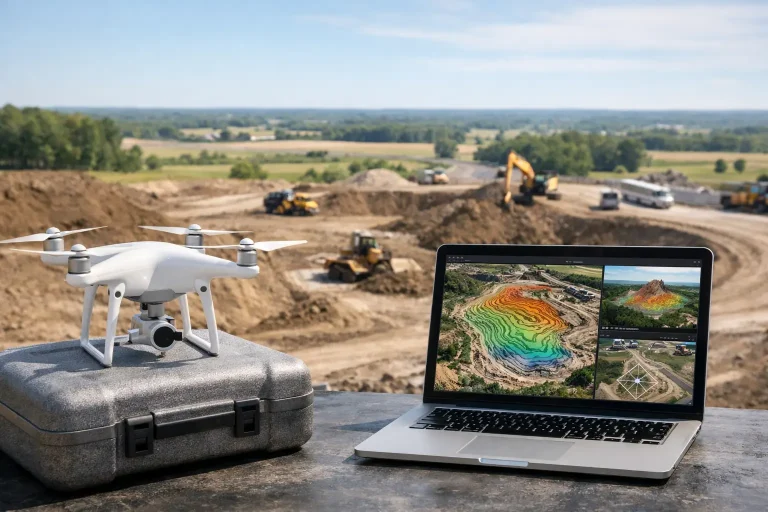
Aerial mapping uses drones, calibrated sensors and photogrammetry processing to turn overlapping images into measurable site data. That can include orthomosaic maps, 3D surface models, topographical information, contour data and volumetric calculations. In specialist settings, it can also extend to multispectral analysis, utility overlays and condition mapping.
The practical value is straightforward. Instead of relying on ground-level assumptions or fragmented records, you get a site-wide view tied to precise coordinates. On a golf course, that might mean identifying low spots affecting playability, mapping irrigation infrastructure, comparing bunker shapes against design intent or understanding how drainage patterns interact with maintenance regimes. On a construction site, it may be progress verification and cut-and-fill quantities. On a commercial property, it may be a safer route to assess roof condition and surrounding assets.
Not every project needs the same level of detail. That matters. A club manager reviewing general layout changes has different requirements from an architect preparing redesign work or an irrigation specialist needing accurate base mapping. The right aerial survey is always defined by the decisions it needs to support.
An aerial mapping guide to choosing the right output
The biggest mistake buyers make is asking for a drone survey before deciding what they need to receive at the end. Aerial mapping should be specified by output, not by aircraft.
If the goal is broad visual understanding, an orthomosaic map may be enough. This is a high-resolution stitched image corrected for scale and perspective, allowing consistent measurement across the site. It is often the most immediately useful format because teams can review holes, paths, water bodies, tree lines and built assets in one coherent view.
If the objective is terrain analysis, drainage planning or earthworks design, you usually need more than imagery. A digital surface model or topographical dataset provides elevation information, which is where serious operational value begins. Contours, slope profiles and surface changes help identify how water moves, where problem areas begin and how proposed works may perform.
For asset management, overlays can be just as important as the base map. Irrigation lines, valve locations, drainage runs, yardage references and maintenance zones become more powerful when placed onto a current aerial plan. It turns a static map into a working document.
Where vegetation performance is under scrutiny, multispectral data can add another layer. This is particularly relevant on golf courses where subtle plant stress may appear before it becomes obvious from ground level. It is not a replacement for agronomic judgement, but it can direct attention to the right areas faster.
Why accuracy matters more than image quality
Crisp aerial photography looks impressive, but image quality alone does not make mapping reliable. The critical factor is positional accuracy. If your outputs are going to inform drainage works, redesign proposals, irrigation planning or contractor measurement, centimetre-level precision can make the difference between confidence and costly rework.
Accuracy depends on flight planning, control points, sensor quality, processing workflow and operator competence. This is where there is a clear divide between professional mapping and basic drone capture. A beautifully edited overhead image may be suitable for marketing. It is not automatically suitable for measurement.
That distinction matters particularly on golf courses, where subtle gradients influence drainage performance, surface firmness and playability. It also matters in construction, where volume calculations and progress records need to stand up under scrutiny. If a dataset will feed into design or operational systems, it has to be built on a dependable survey process.
When aerial mapping is the right choice
Drone mapping is exceptionally effective when you need fast, repeatable site coverage across a large or complex area. Golf courses are an obvious example because they combine terrain variation, dispersed infrastructure, landscaped features and constant operational demands. Walking the site provides local detail, but it rarely gives a complete spatial picture.
It is also a strong option when access is awkward or safety is a concern. Roof inspections, steep banks, water edges and active worksites can all be reviewed with less disruption than traditional methods. That does not mean drones replace every ground survey. There are projects where ground-based verification remains essential, especially around dense tree cover, obscured utilities or locations where the required tolerance is exceptionally tight.
The best approach is often a combination. Aerial mapping provides broad, current, high-detail site intelligence, while targeted ground checks add confirmation where needed. For many clients, that hybrid model delivers the best balance of speed, cost and confidence.
How the process usually works
A professional aerial mapping project begins with a scoping conversation. This is where the intended use of the data should be established clearly. Are you planning winter drainage works, reviewing irrigation coverage, preparing a redesign, inspecting built assets or tracking site change over time? The answer shapes the deliverables, flight method and processing standard.
The next stage is site and airspace assessment. Safe and compliant operations are non-negotiable, particularly around live venues, neighbouring properties or restricted airspace. Once that is in place, the survey itself can usually be completed quickly, although weather, access and site size still affect timings.
After capture, the real work happens in processing. Imagery is aligned, corrected and converted into usable outputs. Depending on the brief, those outputs may then be annotated, layered with asset information or prepared for import into existing systems. The final handover should not feel like a folder of files with no context. It should give the client something practical to work with.
That last point is often overlooked. A technically strong survey still falls short if the outputs are awkward to use. Good aerial mapping is not just accurate. It is usable by the people making day-to-day decisions.
What golf clubs should look for in an aerial mapping guide
For golf sites, the most valuable mapping tends to sit between agronomy, operations and long-term planning. The course manager wants clarity on maintenance priorities. The irrigation consultant wants dependable layout data. The architect wants an accurate base for design review. The committee wants visual evidence that explains cost and need.
That is why specialist understanding matters. A mapping provider who understands golf will approach the site differently from a generalist operator. They will recognise the relevance of green surrounds, drainage corridors, bunker form, cart paths, outfalls, shade patterns and irrigation infrastructure. They are more likely to structure outputs around practical use rather than raw capture alone.
This is where a specialist business such as Vantage Imagery Limited adds value – not simply by flying a drone, but by delivering precision-led outputs that support course management and improvement decisions.
Common misconceptions about drone mapping
One common assumption is that aerial mapping is only worthwhile on very large sites. In reality, smaller and medium-sized sites often see value quickly because recurring issues become easier to isolate and explain. A compact course, a clubhouse roof, a practice facility or a focused development zone can all benefit from current, measurable aerial data.
Another misconception is that one survey solves everything. It depends on the problem. A single baseline survey is powerful, but repeated surveys can reveal change over time, which is often where operational insight deepens. Seasonal comparisons, construction stages and post-works verification are all strong use cases.
There is also the belief that all drone providers offer the same result. They do not. The spread in technical standard, processing quality and practical interpretation is significant. Buyers should ask how accuracy is achieved, what deliverables are included and how the outputs will support the intended decision.
How to judge return on investment
The return from aerial mapping is not always measured by the survey cost alone. It is often seen in reduced guesswork, faster planning, better contractor coordination and more defensible investment decisions. If drainage works are targeted more accurately, if irrigation upgrades begin with reliable base data, or if asset issues are identified before they become disruptive, the mapping has already done more than produce images.
There is also value in alignment. When managers, consultants and committees are working from the same accurate visual record, conversations become clearer and decisions tend to move faster. That can be just as important as the technical data itself.
If you are considering aerial mapping, start with the operational question rather than the technology. The strongest projects are not built around flying for the sake of it. They are built around giving the right people a clearer, more accurate view of what needs attention next.
