 Skip to main content
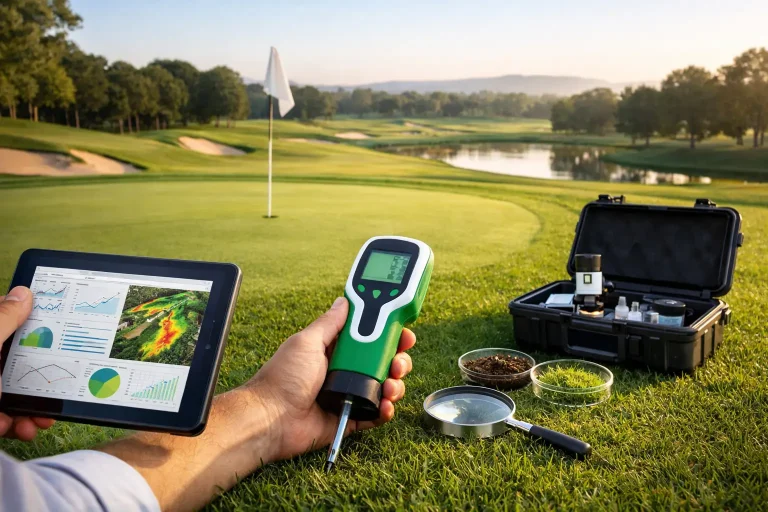
A green that looks slightly off-colour on Monday can become a costly problem by Friday. That is why golf course plant health analysis matters – not as a nice visual extra, but as a practical management tool for protecting playing quality, controlling input costs and spotting turf stress before it becomes visible from ground level.
For course managers and greenkeeping teams, the challenge is rarely a lack of effort. It is a lack of full-site visibility. Walking the course will always matter, but it only shows what is visible in that moment and from that angle. Multispectral aerial data adds a different layer of intelligence. It shows where turf is under pressure, how stress patterns are spreading and which areas need attention first.
What golf course plant health analysis actually shows
Plant health analysis uses drone-mounted multispectral sensors to measure how turf reflects light beyond the visible spectrum. Healthy grass reflects light differently from stressed grass, and that difference can be mapped across fairways, greens, approaches, tees and rough.
The result is not simply a set of attractive images. It is a spatial dataset that highlights variation in vigour, moisture response and growing performance. In practical terms, that means teams can see where turf is declining before widespread thinning, discolouration or loss of density becomes obvious on the ground.
This is particularly valuable on larger sites where microclimates, soil variation, wear patterns and irrigation performance can create very localised issues. One part of a fairway may be drying out, while another is overwatered. One green collar may be showing early disease stress, while the putting surface still appears acceptable to the eye. Plant health mapping helps reveal those inconsistencies with far greater clarity.
Why visual checks alone are not enough
Experienced greenkeepers are exceptionally good at spotting change. The issue is scale. A golf course is a complex managed landscape, and subtle deterioration does not always present itself clearly during routine inspections.
Ground-level assessments can also be influenced by light conditions, recent mowing, dew, shadow, traffic and the simple reality of time pressure. If the team is already dealing with irrigation faults, bunker work, disease pressure and competition preparation, some patterns can be missed until they become expensive.
Golf course plant health analysis does not replace agronomic judgement. It sharpens it. It gives managers and consultants a way to validate what they suspect, challenge assumptions and prioritise inspection areas with better evidence.
That distinction matters. Data without practical interpretation has limited value. Equally, judgement without complete visibility can lead to broad-brush decisions where a targeted response would have been more effective.
Where the biggest operational value comes from
The strongest value usually comes from early intervention. Turf stress is easier and cheaper to manage when it is caught early. By identifying affected zones sooner, teams can adjust irrigation, inspect drainage performance, review localised compaction, assess nutrient uptake or investigate disease pressure before a wider decline sets in.
There is also a clear efficiency gain. Rather than applying the same response across an entire hole or maintenance block, managers can focus labour and inputs where the need is greatest. That can support more intelligent use of water, fertiliser, wetting agents and treatment applications.
On high-value playing surfaces, the margin for error is small. Greens, surrounds and approaches often need the closest monitoring because small changes in plant health can quickly affect firmness, trueness and presentation. Fairways and out-of-play areas also benefit, particularly where irrigation coverage is inconsistent or where drainage and construction history create uneven performance.
Turning aerial data into turf decisions
The most useful surveys are not treated as standalone imagery exercises. They are part of a decision-making process. Once a plant health survey identifies areas of concern, those zones can be checked on the ground and compared against known site conditions.
A stressed area might indicate poor irrigation coverage, but it could also point to rootzone issues, localised dry patch, compaction, disease onset, shade pressure or wear. The aerial layer narrows the search. That saves time and improves confidence in the next action.
When survey outputs are aligned with irrigation layouts, drainage maps or topographical data, the insight becomes even stronger. If recurring stress follows a pipe run, a sprinkler arc or a poorly drained basin, the cause is easier to isolate. That is where survey-grade drone work has a real advantage over generic aerial photography. Precision matters because turf issues rarely follow neat boundaries.
The role of timing in golf course plant health analysis
Timing has a direct impact on usefulness. A survey carried out after prolonged dry weather may expose irrigation shortfalls very clearly. A survey taken during a disease-prone period may reveal emerging patterns of stress before visible scarring develops. Seasonal comparison can also show whether a problem area is improving, stable or getting worse.
There is no single perfect moment for every course. It depends on the management objective. If the goal is irrigation review, the survey should align with likely moisture stress periods. If the goal is monitoring recovery after renovation or construction work, then repeatable scheduled capture may be more valuable.
This is why a consultative approach matters. The best outputs come from matching the flight and analysis to the question being asked, rather than simply collecting data for the sake of it.
What to expect from a high-quality survey
A credible plant health survey should deliver more than broad colour differences. Commercial clients need consistent, georeferenced outputs that can be compared, shared and used in planning. Accuracy is particularly important when findings need to be matched against irrigation assets, drainage lines, maintenance records or specific management zones.
Good reporting should make the data usable. That means clear mapping, sensible interpretation and outputs that help a course manager or consultant decide what to inspect next. Overcomplicating the presentation can slow decisions. Oversimplifying it can hide important nuance.
There is also a difference between spotting stress and diagnosing cause. A survey identifies where the turf is performing differently. It does not automatically prove why. That is where field knowledge, agronomic review and supporting mapping data are essential.
Common scenarios where analysis pays off
Courses often see the strongest return where problems are persistent but not fully explained. Recurring weak turf on fairway shoulders, patchy summer decline on south-facing banks, inconsistent establishment on newly shaped features and moisture-related variability around greens are all strong candidates.
It is also highly effective before capital works. If a club is planning irrigation upgrades, drainage improvement or course alterations, a current plant health baseline can help justify investment and focus budgets on the areas under the most pressure.
For clubs that host events or need consistently strong presentation, analysis can support better preparation. It helps identify where intervention is needed before visual decline affects playability or member perception.
Why specialist golf knowledge matters
A golf course is not just another green space. It is a managed sporting surface with very different expectations across different areas of the site. Greens, tees, fairways, semi-rough and practice areas all behave differently and carry different performance requirements.
That means survey work should be interpreted in the context of golf operations. A weak patch on a rough margin may be a lower priority than subtle stress affecting a green approach or a high-traffic tee surround. Understanding those priorities makes the output more commercially useful.
This is where a specialist provider adds value. Vantage Imagery Limited approaches aerial plant health analysis as part of a wider golf course intelligence service, combining precision capture with mapping outputs that support maintenance planning and operational decision-making.
Making better decisions, not just collecting more data
The real point of golf course plant health analysis is not to create another report. It is to help the right people act earlier and with more certainty. For some courses, that means reducing wasted irrigation. For others, it means proving where drainage faults are influencing turf quality. In many cases, it simply means seeing the course more clearly.
There is always a trade-off between cost, detail and frequency. Not every club needs constant monitoring, and not every stressed area justifies a major intervention. But where turf performance affects presentation, maintenance spend and member experience, better visibility usually leads to better decisions.
The courses that gain the most are often the ones that treat aerial analysis as part of an ongoing management system rather than a one-off exercise. When used properly, it becomes a practical layer of evidence – one that helps teams respond with precision instead of guesswork.
If you are already making high-stakes decisions on irrigation, drainage and turf inputs, clearer plant health data is not an added extra. It is a smarter starting point.
