 Skip to main content
A drainage line that is 150mm out on a plan does not stay a drawing problem for long. It becomes a missed outfall, a badly judged fall, a wasted contractor visit or a recurring wet area that keeps coming back. That is why the real question is not simply are drone surveys accurate enough, but accurate enough for what decision you need to make.
For golf courses, estates, construction sites and large commercial grounds, drone surveys can be extremely accurate when they are planned and delivered properly. In many cases they provide survey-grade outputs with centimetre-level precision, fast turnaround and excellent visual context. But accuracy is not a fixed promise attached to every drone flight. It depends on equipment, ground control, flight planning, site conditions, processing and the type of output you actually need.
Are drone surveys accurate enough for professional use?
In short, yes – often more than enough. For topographical mapping, orthomosaics, digital surface models, stockpile measurement, irrigation planning, drainage investigation, roof inspections and progress tracking, a well-executed drone survey can deliver highly dependable data.
The key distinction is between consumer-grade imagery and professional aerial surveying. A drone with an ordinary camera flown without control points may produce useful visuals, but it is not the same as a calibrated, planned survey workflow designed to achieve measurable accuracy. Professional operators use survey methods, not just flying skills.
That matters especially on golf courses. Greens, bunkers, fairway drainage routes, irrigation infrastructure and subtle surface changes all require more than attractive aerial images. They require positional confidence. If data is going to inform excavation, redesign, turf management or investment decisions, the survey has to stand up technically as well as visually.
What accuracy can a drone survey realistically achieve?
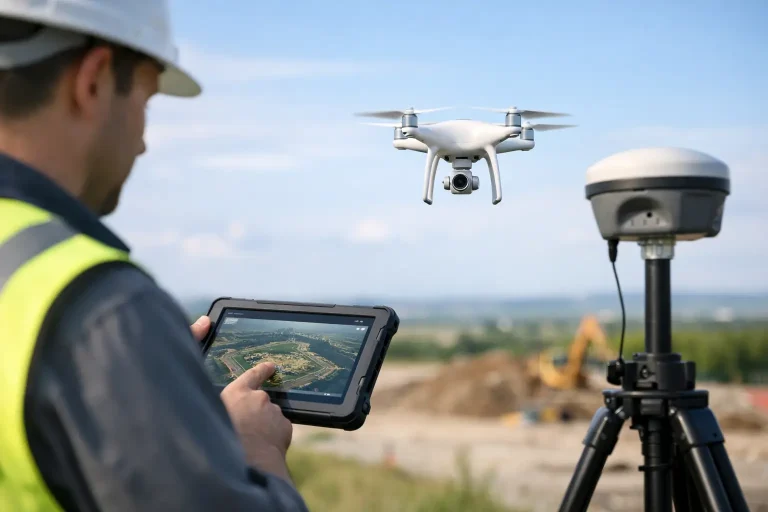
When supported by RTK or PPK positioning and tied to properly surveyed ground control points, drone mapping can achieve horizontal and vertical accuracy within a few centimetres. On the right site, with the right workflow, that is more than sufficient for a wide range of commercial applications.
In practical terms, that level of precision is strong enough to map fairway extents, identify drainage patterns, measure earthworks, locate visible assets, calculate volumes and build detailed topographical models. It is also highly effective for overlaying irrigation layouts, planning maintenance operations and tracking change over time.
However, not every project needs the same standard. If the purpose is promotional photography or broad visual inspection, exact survey control may be less critical. If the data will be used for design, engineering decisions or integration into management systems, the tolerance becomes far tighter. Good survey providers start with the intended use because that determines the required method.
Horizontal accuracy and vertical accuracy are not the same
This is where expectations can drift. A map may look perfectly aligned from above yet still be less precise in elevation than a client expects. Horizontal accuracy refers to how correctly features are positioned across the ground. Vertical accuracy refers to height data – critical for drainage, contour modelling and grading analysis.
For course managers and consultants, vertical accuracy is often the more important test. Surface water does not care whether a map looks sharp. It follows gradients, levels and low points. If a survey is being used to assess falls, wet areas or drainage intervention, the elevation model has to be good enough to support those judgments.
What affects drone survey accuracy?
Accuracy comes from the whole workflow, not one premium drone. The first factor is positioning. RTK and PPK systems improve georeferencing significantly, but they work best when combined with well-placed ground control and check points surveyed on the ground.
The second factor is flight design. Height above ground, image overlap, camera angle and flight speed all influence the final model. If overlap is too low or the flight is rushed, the software has less reliable information to build from. For sites with subtle terrain changes, the capture plan has to reflect that.
The third factor is the ground itself. Dense tree cover, reflective surfaces, standing water, repetitive textures and featureless areas can reduce model quality. Golf courses are generally well suited to drone mapping, but wooded margins, deep shadows and water hazards still require careful handling.
Processing also matters more than many buyers realise. Photogrammetry software can produce impressive outputs quickly, but poor settings, weak control or insufficient quality checks can introduce errors. Accurate surveying is as much about validation as capture. Any serious provider should be able to explain how they verify the final dataset.
Where drone surveys perform exceptionally well
Large sites are where drones often deliver the strongest operational value. A golf course, for example, is difficult to understand from ground level alone. Aerial mapping gives a connected view of every hole, path, bunker, water feature and managed area in one coordinated dataset.
That makes drone surveys particularly effective for topographical overviews, drainage mapping, irrigation planning and vegetation monitoring. They are also excellent for identifying patterns that are hard to see from the ground, such as repeat saturation areas, surface wear routes or changes in turf vigour across wider playing corridors.
For construction and facilities work, drones are equally strong for roof inspections, façade review, stockpile measurement and progress tracking. They reduce the time spent walking large sites and often cut the need for temporary access equipment during early-stage inspections.
This is where a specialist provider adds value. Vantage Imagery Limited, for example, focuses on turning precision aerial data into practical outputs that support course management, maintenance planning and asset visibility, rather than supplying generic imagery with little operational use.
Where drone surveys are not enough on their own
There are limits, and a credible survey partner should be clear about them. Drones do not see through dense vegetation. They do not directly detect buried utilities unless there is supporting evidence or pre-existing utility information to overlay. They also cannot replace every element of a ground survey where legal boundaries, underground services or very tight engineering tolerances are involved.
If you need to verify hidden infrastructure, establish boundary positions for legal purposes or capture areas under canopy with high precision, a drone survey may need to be combined with GNSS, total station, utility survey or laser scanning methods. In some projects, that hybrid approach is the best answer rather than a compromise.
This is not a weakness of drone surveying. It is simply the difference between choosing the right tool and expecting one tool to do everything.
Are drone surveys accurate enough for golf course decisions?
For many golf course applications, absolutely. They are highly effective for mapping hole layouts, measuring managed areas, reviewing bunker form, assessing drainage routes, locating visible irrigation features, analysing surface movement and building clear records for consultants and contractors.
They are also valuable because they turn scattered observations into a site-wide view. A greenkeeping team may know where the recurring problems are, but aerial data helps quantify them and relate them to surrounding levels, pathways, run-off routes and infrastructure. That leads to better planning and fewer assumptions.
The real advantage is not accuracy in isolation. It is accurate data presented in a form that supports action. A centimetre-accurate model is useful, but only if it is delivered as something the client can use for planning, budgeting or operational control.
The best question to ask a survey provider
Instead of asking for a drone survey and hoping it will be accurate enough, ask what tolerance is achievable for your intended use and how it will be checked. Ask whether ground control will be used, what outputs you will receive, what site conditions could affect results and where a ground-based method may still be needed.
That conversation separates serious survey services from generic drone operators very quickly.
Accuracy is only valuable when it changes decisions
A technically impressive dataset has limited commercial value if it does not improve maintenance planning, reduce uncertainty or save time on site. The strongest drone surveys do both. They provide positional confidence and they make the site easier to manage.
So, are drone surveys accurate enough? In many professional settings, yes – decisively so. But the right standard is not measured by marketing claims. It is measured by whether the data is dependable for the job at hand, from drainage diagnosis to irrigation planning to long-term course development.
If a survey helps you act earlier, specify work more clearly and avoid costly guesswork, that is when accuracy stops being a technical feature and starts becoming a business advantage.
