 Skip to main content
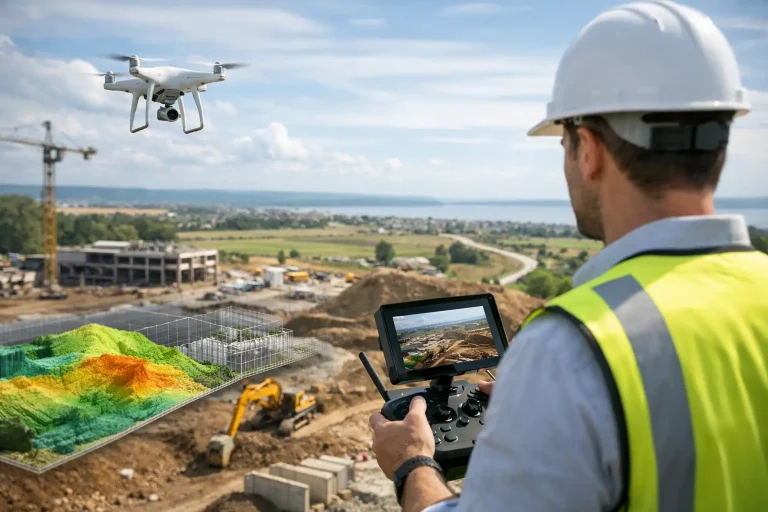
A blocked drain line on a fairway, a roof defect missed from ground level, or a construction site that has shifted since last month – these are the moments when the benefits of drone surveys stop being theoretical and start affecting cost, time and decision-making. For site managers, course teams and property professionals, the real value is not simply getting images from above. It is getting accurate, usable data quickly enough to act on it.
Drone surveys have moved well beyond basic aerial photography. With the right platform, workflow and processing, they deliver high-resolution mapping, measurable terrain models, asset visibility and repeatable site records. For golf courses in particular, where drainage, irrigation, surface performance and presentation all intersect, that combination is especially powerful.
Why the benefits of drone surveys are now hard to ignore
Traditional survey methods still have an important place. On some projects, a ground crew with total stations or GNSS equipment will remain essential, particularly where dense tree cover, tight access or legal constraints limit aerial capture. But for many commercial sites, drone surveying offers a better balance of speed, coverage and cost.
The main shift is practical. Instead of commissioning a survey and waiting weeks for limited outputs, managers can now obtain a full visual and spatial record of a site in a fraction of the time. That matters when maintenance windows are tight, budgets are under pressure and every decision needs evidence behind it.
1. Faster data collection across large areas
Speed is one of the clearest advantages. A drone can capture extensive areas far more quickly than a purely ground-based approach, especially on sites with varied terrain. On a golf course, that means fairways, greens surrounds, bunkers, water features, paths and out-of-play areas can be documented in one coherent dataset rather than pieced together from separate inspections.
For construction and estate management, the same principle applies. A single flight can record stockpiles, progress areas, roof sections and access routes without repeated manual checks. Faster capture does not just save time on site. It also shortens the gap between identifying an issue and responding to it.
2. High-accuracy mapping that supports real decisions
Aerial data only becomes valuable when accuracy is good enough for operational use. Survey-grade drone workflows can produce centimetre-accurate outputs, including orthomosaics, contour plans and digital surface models. That level of precision changes what the data can be used for.
For golf course managers, accurate mapping helps with irrigation planning, drainage investigations and understanding how features relate to one another across the course. For architects and consultants, it provides a reliable base for renovation planning. For contractors, it gives a measurable reference point rather than an impressionistic aerial view.
This is where there is an important distinction. Not every drone operator is delivering survey-quality results. If the workflow lacks proper control, calibration or processing discipline, outputs may look impressive while falling short on positional accuracy. The benefit comes from precision, not simply from flying a drone.
3. Better visibility of assets and problem areas
Many site problems are easier to understand from above. Surface water pathways, worn traffic lines, weak turf zones, pond edge changes, roof deterioration and inaccessible boundary issues often become clearer in a top-down view than they do from ground level.
That visibility is particularly useful on golf courses, where issues are often spread across a large and visually complex landscape. A drone survey can reveal how isolated symptoms connect to a wider pattern. A soft area near a green may relate to upstream drainage. Repeated turf stress may align with irrigation coverage or shaded zones. Seeing the whole site in context makes troubleshooting more accurate.
4. Safer inspections with less disruption
One of the strongest commercial benefits of drone surveys is risk reduction. Roof inspections, elevated structures, steep embankments and unstable ground all create safety concerns when approached through traditional access methods. Drones reduce the need for ladders, scaffolding or prolonged work in hazardous areas.
There is also less disruption to normal operations. On active commercial sites, reducing foot traffic in sensitive or high-risk areas is useful in itself. On golf courses, planned flights can often be carried out with minimal impact on play compared with more intrusive inspection methods. Safer access and lighter operational impact is a strong combination.
5. Lower survey costs over time
Drone surveys are not always the cheapest option for every job. A very small site or a highly obstructed area may still be more efficiently handled another way. But across larger sites and repeat survey programmes, cost efficiency becomes obvious.
The reason is straightforward. A single visit can capture a wide range of outputs, from mapping and elevation data to condition imagery and progress records. That reduces the need for multiple separate inspections. When the outputs feed directly into maintenance planning, contractor briefing or asset management, the commercial return improves further.
For clients managing ongoing change, such as course improvement works or phased construction, repeat flights create a consistent record without repeated heavy survey mobilisation.
6. Stronger planning for drainage and irrigation
This is one area where aerial survey data becomes immediately useful rather than simply informative. Understanding gradients, surface flow paths and infrastructure layout is vital when diagnosing drainage issues or improving irrigation performance.
On golf courses, drone mapping can support the identification of low spots, run-off patterns and areas where existing infrastructure may not be performing as intended. Combined with utility overlays and existing system records, the result is a far clearer basis for intervention. Instead of reacting to visible symptoms alone, teams can plan works around measurable site conditions.
That does not mean a drone survey replaces every specialist assessment. Subsurface issues still require experienced interpretation and, in some cases, supplementary investigation. But as a planning layer, high-quality aerial mapping gives maintenance teams and consultants a much stronger starting point.
7. Improved monitoring of turf and vegetation health
Standard aerial imagery is useful, but multispectral surveying goes further by highlighting patterns in plant health that are not always visible to the eye. For turf managers, that can help identify stress, poor establishment, inconsistent vigour or areas affected by water distribution and compaction.
The value here is timing. Spotting changes earlier gives teams a better chance of targeted intervention before problems become more expensive to correct. It also supports a more measured approach to inputs. Rather than treating broad areas based on assumption, management can be focused where the data points.
As with any diagnostic tool, interpretation matters. Multispectral data is powerful, but it works best when read alongside local knowledge, weather conditions and agronomic context.
8. Clearer communication with stakeholders
A good survey should not only help the technical team. It should also make decisions easier to explain to committees, owners, contractors and consultants. Drone outputs do this well because they combine accuracy with visual clarity.
When a manager needs to justify drainage works, show the scale of bunker renovation, or evidence progress on a construction phase, aerial mapping gives everyone the same point of reference. Misunderstandings reduce when stakeholders can see the site clearly and understand exactly where work is proposed.
This matters in commercial settings where budget approval often depends on making a technical case in a concise, credible way.
9. Reliable progress tracking over time
One survey is useful. A sequence of surveys is often where the bigger value appears. Repeatable aerial capture allows sites to be monitored over weeks, months or seasons, creating a consistent visual and measurable timeline.
For construction managers, this helps with progress validation, contractor oversight and record keeping. For golf clubs, it can support renovation planning, seasonal comparisons and long-term asset management. The ability to compare like-for-like views over time gives teams a more objective basis for reviewing what has changed and whether interventions are delivering results.
Consistency is key here. To make comparisons meaningful, capture methods and output standards need to be controlled properly.
10. More practical outputs than standard aerial imagery
One of the most overlooked benefits of drone surveys is that the output can be tailored to the job. A commercial client rarely needs pictures for their own sake. They need data they can use inside operational workflows.
That might mean topographical mapping for design work, roof imagery for maintenance scheduling, utility overlays for project planning, or orthomosaics that support irrigation system management. The real value sits in how well the survey translates into action. The best drone surveys are not generic. They are built around the decisions a client needs to make next.
Where drone surveys deliver the strongest return
Drone surveying tends to deliver the best value on sites that are large, complex, frequently changing or difficult to inspect efficiently from the ground. Golf courses are an obvious fit because they combine scale, terrain variation, underground infrastructure and constant maintenance pressure. Construction sites, estates and commercial properties also benefit for similar reasons.
The trade-off is that expectations need to match the brief. If a client wants survey-grade outputs, the project must be planned and executed to survey standards. If the objective is only visual marketing content, that is a different service entirely. Clear scope leads to better results.
For organisations that need precision, speed and usable site intelligence, the case is now strong. The technology is established. The real differentiator is working with a specialist provider who understands how to turn aerial data into operational value.
A drone survey is at its best when it helps you see a site more clearly than before, and then act on that clarity with confidence.
