 Skip to main content
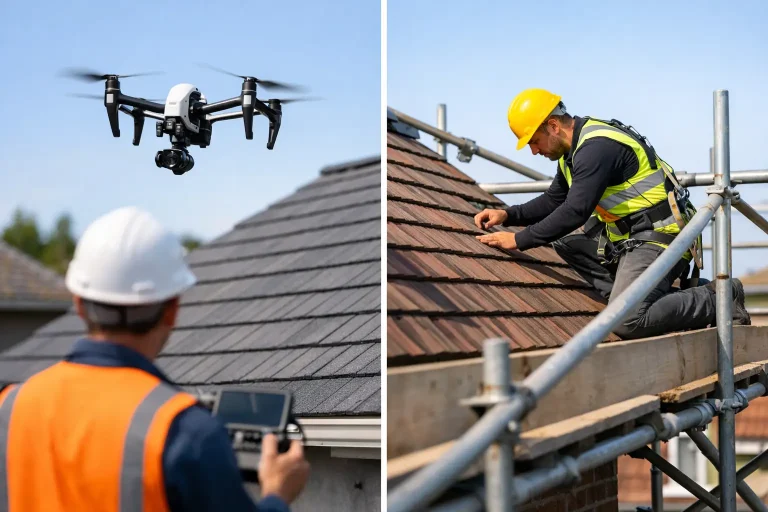
If a roof defect is delaying maintenance decisions, waiting days for access equipment rarely feels like good asset management. That is why the question of drone roof inspection vs scaffold matters so much for commercial property owners, facilities teams and site managers. The right method affects not only cost, but also speed, safety, disruption and the quality of information you can actually use.
For many inspections, a drone is the more efficient option. It can capture high-resolution imagery quickly, reduce work at height, and give decision-makers a clear visual record of the roof condition without the delay of erecting temporary access. That said, scaffolding still has a place. If repairs need to begin immediately, or a hands-on intrusive inspection is required, physical access may be unavoidable. The better question is not which method is always best, but which one is right for the building, the defect and the next decision you need to make.
Drone roof inspection vs scaffold: what changes in practice?
The biggest difference is the type of access each method provides. A drone gives visual access. It allows a qualified operator to inspect coverings, flashings, gutters, parapets, rooflights, chimney stacks and hard-to-reach areas from multiple angles, often within a single site visit. Scaffolding provides physical access. It allows surveyors, contractors or engineers to stand on or beside the structure and carry out close-contact inspection, testing or repair.
That distinction sounds simple, but it shapes the whole project. If your immediate goal is to identify slipped tiles, blocked outlets, membrane damage, standing water, failed detailing or visible storm damage, a drone can often provide the evidence far faster. If your objective is to open up construction, probe hidden defects, replace materials or carry out remedial works, scaffold becomes part of the operational requirement.
For commercial sites, the speed difference is often decisive. A drone survey can usually be planned and completed with far less setup than scaffold. There is no need to close off as much ground area, manage a prolonged site presence or wait for access infrastructure before the first images are captured. When a facilities manager needs clear evidence for budgeting or contractor instruction, that time saving has real commercial value.
Where drones are strongest
A professional drone roof inspection is particularly effective when the priority is rapid condition assessment. High-resolution imagery can reveal cracked tiles, defective leadwork, loose ridge lines, failed seams, vegetation growth, ponding and drainage issues. For larger buildings, it also creates a complete visual overview that is difficult to achieve from ladders or isolated access points.
That broader perspective matters. One of the common limitations of traditional access-led inspection is that it can become too localised. You might gain excellent visibility in one area while missing how defects relate across the full roofscape. A drone can document the whole asset first, then allow attention to narrow onto the specific problem areas.
This is especially useful on buildings with complex geometry or roofs that are awkward to inspect safely from the ground. Commercial units, clubhouses, leisure buildings, schools and managed estates often have multiple elevations, valleys, extensions and service penetrations. In those cases, drone imagery turns a difficult visual problem into a clear dataset.
There is also a reporting advantage. Images and video give stakeholders a shared evidence base. That makes it easier to brief contractors, justify maintenance spend and compare roof condition over time. For organisations managing several assets, consistency in inspection output can be just as important as the inspection itself.
Where scaffold still earns its place
Scaffold is slower and more expensive in many scenarios, but that does not make it outdated. It simply serves a different purpose. If a structural engineer needs tactile inspection, if a surveyor must test material integrity, or if contractors are moving straight into repairs, scaffold may be the correct choice.
The same applies where the concern is not fully visible from the exterior. Moisture ingress, substrate failure and hidden junction issues may require physical investigation. A drone can indicate where the problem is likely to be, but it cannot lift coverings or verify concealed construction.
There are also environments where physical access is preferred because the roof inspection is tied directly to broader works. If a refurbishment programme already includes scaffold for façade repair or roofing replacement, adding a separate drone visit may be less useful unless the client wants pre-works records or progress documentation.
So when clients ask whether drones replace scaffold entirely, the honest answer is no. They replace it in many inspection-only situations, and they reduce unnecessary access costs when the first task is diagnosis rather than repair.
Safety and site disruption
Safety is one of the clearest advantages in the drone roof inspection vs scaffold debate. Reducing the need for people to work at height at the inspection stage is a significant benefit. A drone allows condition assessment to happen without placing surveyors or contractors directly on fragile surfaces, steep pitches or weathered roof structures.
That does not mean drone work is risk-free. It still requires competent operators, flight planning, legal compliance and careful management of the surrounding environment. But when compared with erecting scaffold and sending personnel onto the building, the exposure profile is often lower.
Disruption is another factor commercial clients tend to feel immediately. Scaffold can affect access routes, car parking, deliveries, public-facing presentation and day-to-day operations. On active sites, that can create knock-on costs that do not always appear in the initial quote. A drone survey is typically much lighter in footprint and duration, which makes it attractive where business continuity matters.
Cost is not just the day rate
It is easy to compare drone and scaffold on headline price alone, but that can be misleading. Scaffold costs are not only about erection and dismantling. There may be permits, site logistics, programme delays and additional contractor time before the inspection even begins. If the roof proves to be in better condition than expected, that upfront spend can look disproportionate.
A drone inspection is usually more cost-efficient when the aim is to understand condition first and decide on next steps afterwards. It helps prevent overcommitting to access infrastructure before there is evidence that intrusive inspection or immediate repair is necessary.
However, if you already know physical works are needed, scaffold may be the more practical combined solution. Paying for a drone and then erecting scaffold straight away can duplicate mobilisation unless the imagery provides a distinct planning benefit. As with most asset decisions, value depends on sequencing.
Quality of information and decision-making
The best inspection method is the one that produces usable information. Drones excel at generating precise visual evidence quickly, and that supports better decisions. For example, if you are comparing contractor recommendations, planning phased maintenance or documenting storm damage for internal review, detailed aerial imagery gives a clear basis for action.
Advanced operators can go further than simple photographs. Structured image capture, orthomosaic outputs and measured visual records can improve consistency across larger roofs or estates. This is where a specialist surveying approach stands apart from a basic drone flyover. The goal is not just attractive footage, but reliable inspection data that supports maintenance planning.
Scaffold, by contrast, offers a different quality of information – direct physical observation. That can be essential, but only when the decision truly depends on contact-level investigation. If the main question is visible condition, drones often answer it more efficiently.
How to choose the right approach
The most practical way to decide is to start with the next action you need to take. If you need a fast, safe visual assessment to identify defects, prioritise areas and inform budgets, a drone is usually the stronger first step. If you need to carry out remedial work, open up the roof or perform hands-on testing, scaffold is likely to follow.
In many cases, the smartest approach is staged. Use a drone inspection first to map the issues accurately, then deploy scaffold only where physical access is justified. That avoids blanket access costs and helps target repairs with more confidence. For commercial clients focused on efficiency, this often delivers the best balance of speed, evidence and spend.
That is also why specialist operators add more value than generalist providers. Accurate outputs, clear reporting and an understanding of how inspection data feeds into maintenance decisions make the difference between an interesting set of images and a genuinely useful survey. Vantage Imagery Limited works in that precision-led space, where drone technology is used to produce actionable information rather than generic aerial visuals.
When a roof issue appears, the pressure is usually to act quickly. The better move is to act with clarity. Choose the method that matches the decision in front of you, and you will spend less time paying for access you do not need and more time resolving the problem properly.
