 Skip to main content
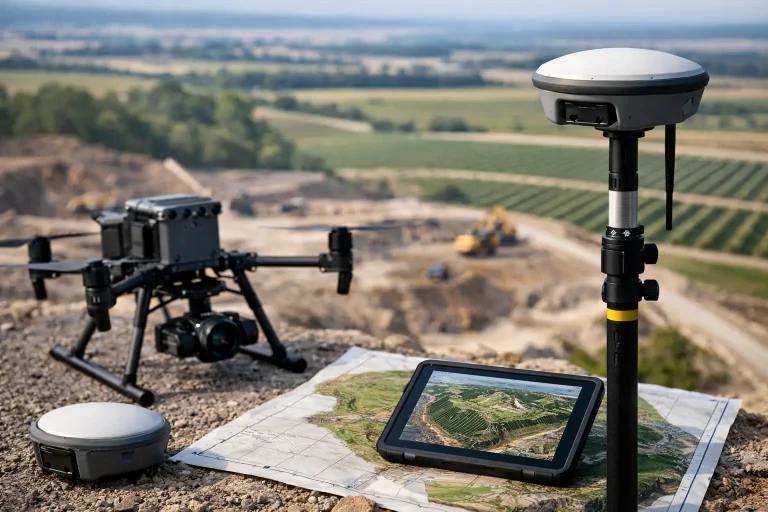
When a client asks for aerial mapping, the real question is usually not whether they need drone imagery. It is whether they need survey grade aerial data that can stand up to operational decisions, design work and asset planning. That distinction matters. A visually impressive image is useful for presentation. Accurate aerial data is useful for measurement, drainage analysis, irrigation planning and change tracking.
For golf courses and managed sites, that gap is often where cost, delay and avoidable mistakes creep in. If a bunker edge is in the wrong place on a base map, if levels are inconsistent across a fairway, or if drainage routes are inferred rather than measured, teams start working from assumptions. Survey grade outputs remove that uncertainty and replace it with dependable spatial information.
What survey grade aerial data actually means
Survey grade aerial data is not a marketing phrase for high-resolution drone photography. It refers to aerially captured data processed and controlled to a standard where positional accuracy is suitable for surveying, mapping and design purposes. In practical terms, that usually means centimetre-level accuracy when the project is planned correctly and supported by the right workflow.
That workflow matters as much as the aircraft itself. Good survey data comes from a combination of flight planning, onboard positioning, ground control where needed, quality checks and specialist photogrammetric processing. Miss one of those elements and the output may still look sharp, but it may not be reliable enough to use as a measurement base.
For clients, the simplest way to think about it is this: if you want to inspect, present or market a site, standard aerial imagery may be enough. If you want to measure, compare, overlay utilities, plan works or feed data into management systems, you need survey grade aerial data.
Why accuracy changes the value of aerial surveys
The commercial value of aerial data rises sharply once it becomes measurable. A course manager looking at a stitched aerial image can identify broad issues, but a manager working from an accurate orthomosaic and surface model can quantify those issues. That changes the conversation from observation to action.
On a golf course, this affects routine operations as much as capital projects. Accurate mapping helps teams understand exact green and tee extents, route irrigation more intelligently, review drainage paths, locate exposed infrastructure and monitor wear patterns over time. For architects and consultants, it provides a dependable base for redesign work without relying on outdated plans or incomplete records.
The same principle applies beyond golf. On construction sites, survey-grade outputs support progress tracking and stockpile measurement. On estates and commercial properties, they improve roof inspection planning, asset visibility and site coordination. The technology is versatile, but the value always comes back to one thing: whether the data is accurate enough to trust.
How survey grade aerial data is produced
Reliable results begin before the drone leaves the ground. The site has to be assessed properly, with the right flying height, image overlap, positioning method and ground conditions taken into account. Complex sites often need a more considered approach, particularly where tree cover, reflective surfaces, steep changes in elevation or restricted access can affect data capture.
The next step is positional control. Depending on the specification, that may involve RTK or PPK drone positioning, ground control points, or a combination of both. This is where many non-specialist providers fall short. They can capture imagery, but without a controlled survey workflow they cannot consistently deliver outputs suitable for design, measurement or integration into other systems.
Processing is equally important. Photogrammetry software can generate point clouds, digital surface models, terrain models and orthomosaics, but software does not guarantee survey quality on its own. The operator has to understand how to clean data, check alignment, identify errors and validate the final product against the project requirement. If the end use is drainage design, the tolerance for vertical inconsistency is very different from a simple visual overview.
Survey grade aerial data for golf course management
Golf is one of the clearest examples of where accurate aerial mapping delivers practical value. A course is a large, complex landscape with constant interaction between turf health, water movement, infrastructure, playability and presentation. Managing that effectively requires a level of visibility that ground-only inspections rarely provide.
Accurate aerial surveys give greenkeeping and management teams a current view of the whole site, not just isolated problem areas. Fairways, greens, bunkers, paths, water bodies and rough can all be mapped consistently. Once that base exists, it becomes far easier to overlay irrigation lines, drainage runs, valve locations or maintenance zones.
That matters because many golf sites are working with partial records, legacy drawings or plans that no longer reflect what is on the ground. Survey grade data provides a cleaner starting point for operational decisions. It can support drainage upgrades, irrigation improvements, machinery route planning, course renovation and long-term capital investment. It also helps consultants and architects collaborate from the same accurate reference.
For turf health analysis, accuracy matters in a slightly different way. Multispectral imagery is powerful, but its value increases when vegetation data can be tied back to precise mapped locations. That makes follow-up action more targeted, especially where teams are investigating localised stress, irrigation performance or recurring weak areas.
Where expectations need to be realistic
Survey grade does not mean every project is identical, and it does not remove the need for judgement. The required output depends on what the data will be used for. A topographical base for concept planning may not need the same specification as an as-built survey feeding directly into engineering design.
Ground cover is one of the biggest variables. Dense tree canopy can obscure the terrain below, which affects how well a drone survey can represent bare earth. In those cases, additional survey methods or selective ground verification may be needed. Water surfaces, highly reflective roofs and feature-poor ground can also introduce processing challenges.
There is also a difference between horizontal and vertical accuracy, and clients are right to ask about both. A dataset can appear aligned in plan view yet still be less reliable in elevation than the project demands. A good provider should be clear about what is achievable on the site, what controls are being used and where any limitations sit.
What to ask before commissioning an aerial survey
If the project depends on measurement, ask how accuracy will be achieved, not just what drone will be used. The platform matters, but the survey methodology matters more. You want to know whether the provider uses controlled positioning, how outputs are checked, and whether the final data is suitable for the decisions you need to make.
It is also worth asking what deliverables you will actually receive. For some clients, an orthomosaic and contour set will be enough. Others may need point clouds, digital terrain models, CAD-ready mapping or utility overlays that can slot into existing management workflows. The right dataset is the one your team can use immediately, not the one with the longest technical specification.
Specialist knowledge of the site type has genuine value too. A provider who understands golf course operations will approach mapping differently from a generic drone company. They are more likely to capture the features that matter, structure outputs around real maintenance and planning tasks, and recognise where centimetre accuracy has day-to-day operational impact. That is a major part of why businesses such as Vantage Imagery Limited focus on precision-led survey outputs rather than generic aerial content.
Why this matters now
Budgets are under pressure, expectations are rising and site teams are being asked to make faster decisions with less tolerance for error. In that environment, poor spatial information becomes expensive. Accurate aerial mapping is not just about having a better view from above. It is about reducing uncertainty before money is spent, ground is broken or maintenance hours are committed.
Survey grade aerial data gives decision-makers a clearer foundation. It supports better planning, sharper prioritisation and more confident communication between managers, consultants, contractors and owners. When the data is right, the next decision tends to be better as well.
The useful question is not whether aerial survey technology is advanced enough any more. It is whether the data you are commissioning is accurate enough to rely on when the work starts.
