 Skip to main content
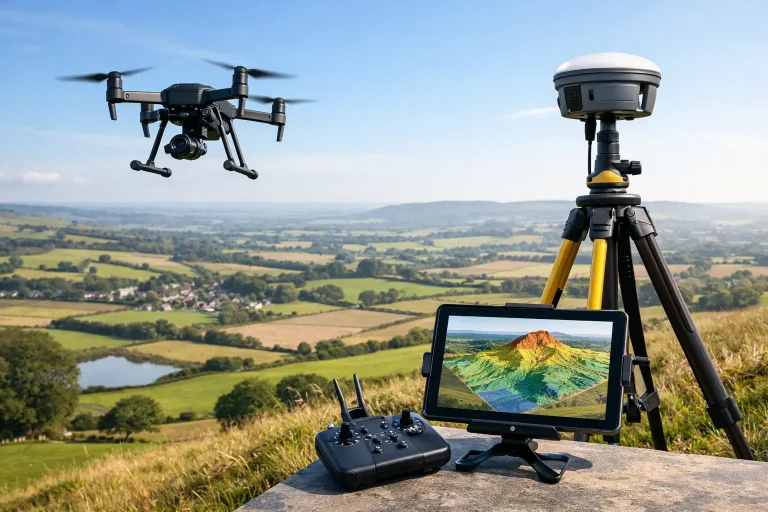
When a course manager needs to understand why a fairway holds water after heavy rain, or a contractor needs current ground levels before setting out works, stale drawings and rough measurements are not enough. A drone topographical survey UK clients can rely on gives you something far more useful – a current, measurable picture of the land, built for decisions rather than guesswork.
That matters because topographical data is only valuable if it reflects what is actually on site. On a golf course, subtle changes in level can affect drainage performance, irrigation planning, bunker redevelopment and playability. On a construction site, the same level of detail can shape earthworks, access planning and progress tracking. In both cases, speed helps, but accuracy is what protects budgets and avoids expensive mistakes.
What a drone topographical survey in the UK actually delivers
A drone survey is not simply a collection of aerial photographs. Carried out properly, it produces survey-grade mapping using photogrammetry, ground control and carefully planned flight operations. The end result can include orthomosaic imagery, digital surface models, contours, spot levels and CAD-compatible outputs that support design, maintenance and planning work.
For commercial clients, the real benefit is usability. Survey data needs to fit into existing workflows, whether that means drainage analysis for a golf course, utility planning, overlaying irrigation infrastructure or measuring site change over time. Good drone mapping turns aerial capture into practical information your team can work with straight away.
The strongest use cases tend to be sites where coverage, repeatability and visibility matter. Golf courses are a clear example because they are large, complex and constantly changing. A drone can capture whole holes, transitions, green surrounds, water features and out-of-play areas in one coordinated survey, giving managers and consultants a shared reference point built on accurate data.
Why drone topographical survey UK demand is growing
Traditional surveying remains essential in many situations, especially where dense vegetation, enclosed spaces or highly complex structures limit aerial capture. But more clients are choosing drone surveys because they close a long-standing gap between speed and precision.
A well-executed drone topographical survey UK businesses use today can cover extensive land quickly without sacrificing the level of detail required for planning and asset management. That is especially valuable when operational windows are tight. Golf courses cannot shut down for days to gather baseline information. Construction sites need updates that reflect current conditions, not last month’s layout.
There is also a commercial advantage in having richer visual context. Standard line drawings can tell you levels and boundaries, but aerial mapping shows the relationship between features. You can see where drainage lines sit against fairway contours, where wear patterns appear near walk-offs, or how access routes are affecting surrounding ground. That visual clarity makes technical conversations easier between owners, managers, consultants and contractors.
Where drone surveys add the most value on golf courses
Golf is one of the clearest examples of where topographical accuracy and practical usability need to work together. A course is not just a single parcel of land. It is a living operational environment with turf performance issues, hidden infrastructure, surface movement, seasonal pressure points and constant maintenance demands.
For drainage projects, accurate level data helps identify how water is moving across a hole and where intervention is likely to have the greatest effect. For irrigation planning, aerial mapping can support system reviews, pipe route understanding and more informed decisions around coverage and efficiency. When clubs are considering redesign work, course architects and consultants benefit from a reliable existing-conditions model before changes are proposed.
There is value in the smaller details as well. Green surrounds, tee complexes, bunker edges, path alignments and water bodies all influence maintenance workload and member experience. With centimetre-accurate mapping, those features can be measured, reviewed and planned with confidence rather than estimated from visual inspection alone.
For clubs managing long-term capital investment, repeat surveys can be just as useful as one-off surveys. Comparing data over time can reveal how landscape features have shifted, where erosion or settlement is emerging, or whether completed works are performing as expected.
Accuracy, and what clients should ask about it
Not all drone surveys deliver the same standard of output. This is where buyers need to look beyond the aircraft itself. The platform matters, but the real difference comes from survey control, flight planning, processing quality and the experience of the operator.
If you are commissioning a drone topographical survey in the UK, ask how accuracy is achieved and validated. Ground control points, check points and clear quality assurance processes are all part of producing dependable mapping. Without them, impressive-looking imagery can still fall short when precise measurements are needed.
It is also worth asking what coordinate system and deliverable formats will be used. Survey data should integrate cleanly with CAD drawings, GIS platforms or specialist management software where relevant. On golf projects, that may include drainage planning documents, irrigation layouts or internal course mapping systems. On construction projects, it may need to feed directly into design and site management workflows.
The best providers are not just collecting data. They are thinking about how that data will be used after delivery.
Speed is an advantage, but not the whole story
Drone surveying is often described as faster than traditional methods, and that is true in many scenarios. Large areas can be captured efficiently, site visits can be less disruptive, and repeat surveys are straightforward to schedule. But speed only becomes valuable when it supports better decisions.
For example, a fast survey is helpful if a contractor needs fresh topographical information before work starts. It is even more helpful if the outputs arrive in a format the design team can use immediately. The same applies to golf course management. Quick aerial capture is useful, but what really matters is whether the final model helps identify drainage falls, track turf stress patterns or support a planned upgrade.
That is why solution-focused providers stand apart from generic drone operators. They understand the operational question behind the survey and shape the output accordingly.
Limits, trade-offs and when a hybrid approach works best
Drone mapping is powerful, but it is not a cure-all. Dense tree cover can obscure the ground. Very steep or enclosed spaces may require a different survey approach. Sites with significant under-canopy detail may still need terrestrial methods or supplementary measurement.
In practice, the best answer is often a hybrid one. Aerial surveying can provide broad coverage, high-quality surface modelling and strong visual context, while ground-based surveying fills in obscured areas or captures specific structural details. That combination gives clients the efficiency of drone capture without pretending every site condition is ideal from the air.
This matters because honest scoping saves time later. A specialist provider should be clear about what drone data will show well, where there may be limitations, and whether additional survey inputs would improve the final result.
Choosing the right survey partner
If the data is going to influence spending, planning or site works, you need more than a pilot with a camera. You need a specialist partner who understands surveying standards, project objectives and the practical demands of the environment being mapped.
For golf clubs, sector knowledge makes a tangible difference. A provider who understands drainage patterns, irrigation systems, playing surfaces and course infrastructure will ask better questions at the start and produce outputs that are more useful at the end. The same principle applies in construction and property management. Technical capability matters, but so does commercial awareness.
Vantage Imagery Limited works in that specialist space, combining advanced drone surveying with practical outputs designed for land management and operational planning. That focus is what turns aerial data into something decision-makers can act on.
What good survey data changes
The most valuable outcome of a drone survey is not the map itself. It is the change in confidence that follows. Teams can plan works against current levels, justify investment with evidence, brief contractors more clearly and spot issues before they become larger problems.
On a golf course, that may mean targeting drainage spend more effectively, reviewing a bunker project with accurate base data or understanding surface flow in a way that site walks alone cannot provide. On a commercial site, it may mean cleaner planning, fewer surprises and better control over progress and ground conditions.
The technology is impressive, but the real point is simpler than that. When you can see your site properly and measure it accurately, better decisions tend to follow. That is why drone surveying is becoming such a valuable tool across land management – not because it looks modern, but because it gives the right people the right information at the right time.
