 Skip to main content
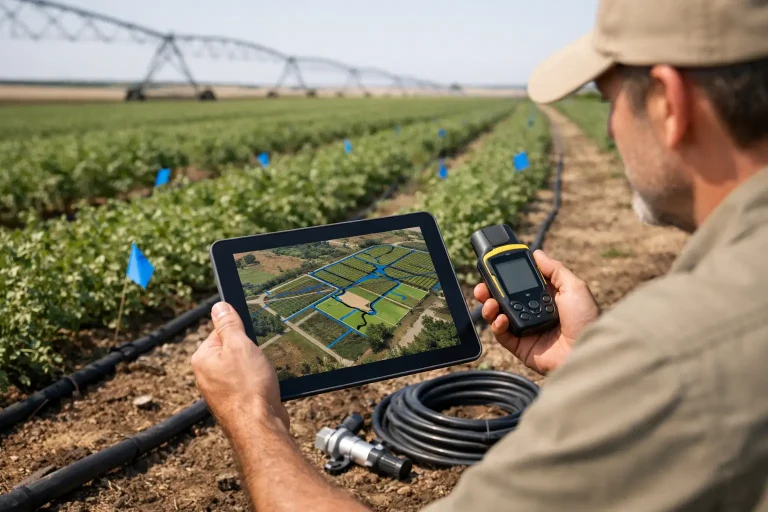
When an irrigation fault appears in the wrong place on paper, everything downstream gets slower – diagnosis, repairs, contractor coordination and budgeting. That is why knowing how to map irrigation lines properly matters. On a golf course or any managed landscape, inaccurate records do more than waste time. They increase excavation risk, complicate maintenance planning and make it harder to connect irrigation performance with drainage, topography and turf condition.
For most commercial sites, irrigation mapping works best as a practical guide rather than a rough sketching exercise. The objective is not simply to draw where pipes might run. It is to create a dependable asset record that reflects real on-site positions, can be checked against visible infrastructure and is useful to greenkeeping teams, irrigation contractors and consultants long after the survey is complete.
What good irrigation mapping should actually deliver
A useful irrigation map shows more than a line between two valve boxes. It should give you a clear picture of pipe routes, lateral runs, control points, heads, valves, manifolds, pumps and any related drainage or utility conflicts where those are relevant. Just as important, it should place those assets in relation to fixed site features such as greens, tees, paths, water features, buildings and boundary lines.
That context is where many older plans fall short. A paper drawing from an installation phase may be broadly right, but if bunker edges have shifted, a path has moved or additional works have been carried out over the years, the plan quickly loses operational value. For course managers, the question is not whether a plan exists. It is whether the plan supports confident decisions.
How to map irrigation lines without guessing
The first step in how to map irrigation lines is deciding what level of accuracy you need. If the map is only for broad reference, a simple marked-up base plan may be enough. If the map will inform trenching, refurbishment, fault diagnosis or integration with irrigation control systems, you need a survey-grade approach.
That usually means starting with an accurate basemap. High-resolution aerial mapping and topographical survey data provide the spatial framework. Once that is in place, irrigation assets can be recorded against real-world coordinates rather than estimated positions. This is where the quality of the final output is won or lost. If the basemap is wrong, even carefully recorded irrigation features will sit in the wrong place.
On a golf course, this matters because irrigation infrastructure rarely exists in isolation. Main lines may track alongside paths, cross fairways, run behind greens complexes or sit close to drainage corridors. Mapping them accurately against current course features makes the data immediately more usable.
Start with visible infrastructure
The easiest elements to capture are the visible ones – valve boxes, sprinkler heads, pump stations, controller locations, chambers and meter points. These should be surveyed directly and attributed clearly. A point on a map is far more valuable when it is labelled with a function, zone reference or asset type.
Visible assets create the control network for interpreting the unseen network below ground. Once you know where the heads, valves and junction points sit, underground routes become more logical to trace and verify. It also makes it easier to identify where historic records do not align with what is physically on site.
Use existing records, but treat them carefully
As-built plans, installer drawings and hand-marked maintenance plans can all help, but none should be accepted at face value. Irrigation systems evolve. Lines get rerouted, valves are replaced, spare heads become active, and repair works are often carried out under time pressure with limited record keeping.
Existing drawings are best used as source material to be tested, not as final truth. In practice, that means overlaying them onto an accurate survey base and checking whether known fixed points line up. If a controller position is right but head spacing is visibly inconsistent with the current layout, the drawing may be only partially reliable.
Verifying underground irrigation routes
The difficult part of irrigation mapping is the pipework you cannot see. There are several ways to approach this, and the right choice depends on site conditions, budget and how critical the map is.
One method is logical reconstruction. If the positions of heads, valves and controls are accurately surveyed, pipe runs can often be inferred with reasonable confidence, particularly in systems with standard layouts. This can work for planning-level outputs, but it has limits. Repairs, retrofits and phased installations can make pipe routing less predictable than it looks from the surface.
A more reliable route is combining survey data with physical detection. Ground-based utility locating methods can help identify buried lines or associated services, especially where metallic tracer wires or detectable components are present. Trial pits may also be used in key areas to confirm depth, direction or pipe material. This adds time, but it reduces assumptions.
For higher-value sites, the strongest result usually comes from layering methods rather than relying on one source. Survey-grade aerial mapping, direct asset capture, historic plan review and selective underground verification create a far more defensible map than any single method alone.
Why drone mapping strengthens irrigation records
Drone surveying does not directly see buried irrigation pipes, but it dramatically improves how irrigation data is structured, visualised and used. That distinction matters. The value is in the geospatial framework.
A centimetre-accurate aerial survey gives you a current orthomosaic and, where required, a detailed terrain model. On a golf course, that means irrigation assets can be positioned precisely against greens, approaches, bunkers, paths, tree lines and maintenance access routes. It also allows irrigation and drainage mapping to be viewed together, which is often where the operational insight appears.
If an area repeatedly struggles with turf stress, the issue may not be irrigation coverage alone. It could be local topography, drainage inefficiency or infrastructure conflict. When the linework sits on a precise mapped base, those relationships become easier to see and easier to act on.
This is the difference between imagery and actionable data. Aerial survey outputs are not just visual aids. They become the working surface onto which utility overlays, irrigation records and maintenance intelligence can be built.
The data standard matters as much as the survey
One of the most overlooked parts of irrigation mapping is attribute quality. A map full of lines and symbols may look complete, but if assets are not labelled properly, it quickly becomes another static drawing nobody trusts.
Each mapped element should carry enough information to be useful in the field. Depending on the project, that may include pipe type, diameter, material, zone reference, installation phase, condition notes or confidence level. Confidence level is especially valuable when some routes are surveyed directly and others are inferred from records or field logic.
This honesty in the dataset is useful, not a weakness. It tells future users where verification has already taken place and where further checking may still be worthwhile before excavation or refurbishment works begin.
Choose outputs your team will actually use
There is no point commissioning precision mapping if the final files sit unused because they are too awkward to access. The best irrigation maps are produced in formats that support day-to-day operations, whether that means CAD outputs for designers and contractors, GIS-compatible datasets for asset management, or clear annotated plans for course teams.
For many golf clubs, the most effective setup is a combination of technical files and simplified visual plans. Consultants and specialists need detailed datasets. On-site teams often need fast-reference plans that show exactly what sits beneath a green surround or fairway crossing without opening a complex software package.
Common mistakes when mapping irrigation lines
The biggest mistake is assuming an old drawing is close enough. Close enough works until a repair crew digs in the wrong place. Another common issue is capturing only the irrigation elements and ignoring the site base. Without accurate positional context, even well-drawn linework has limited value.
There is also a tendency to treat irrigation as separate from other site systems. In reality, drainage, paths, crossings, service routes and topography all affect how irrigation infrastructure is maintained and upgraded. Mapping in isolation often creates more questions than answers.
Finally, some projects aim for total certainty everywhere, which can make costs climb unnecessarily. Not every site needs every metre of pipe exposed or physically verified. The right level of detail depends on the intended use. For strategic planning, selective verification may be enough. For major reconstruction, a higher verification standard is justified.
When to bring in specialist survey support
If your irrigation records are fragmented, outdated or inconsistent with the current layout, specialist support usually pays for itself in reduced uncertainty alone. That is especially true on golf courses, where buried infrastructure, evolving design features and operational downtime all carry cost.
A specialist mapping partner can combine aerial survey, geospatial processing and utility overlay production into one coherent dataset. For businesses such as Vantage Imagery Limited, the real value is not simply producing an attractive map. It is creating precise, usable information that fits maintenance workflows, refurbishment planning and long-term asset visibility.
The strongest irrigation map is the one your team trusts when decisions need to be made quickly. If you are working out how to map irrigation lines, start by thinking less about drawing pipes and more about building an accurate operational record. Once the data is anchored to a reliable survey base, your irrigation system stops being hidden infrastructure and starts becoming a manageable asset.
A good map will not fix a leaking main or a failing valve, but it will make every next decision faster, safer and far more informed.
