 Skip to main content
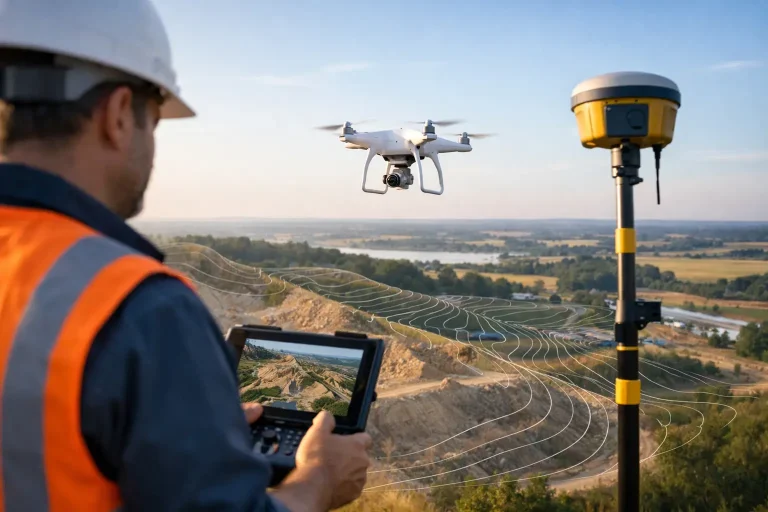
When a course manager needs to understand how water is moving across fairways, or a contractor needs reliable levels before work starts, speed matters – but only if the data is accurate enough to act on. That is exactly why use drone topographic surveys is such a relevant question for land managers, golf professionals and commercial site teams. The real value is not the drone itself. It is the quality of the terrain data, the clarity of the outputs, and how quickly that information can support better decisions.
Traditional topographic surveying still has an essential place, particularly on highly constrained sites or where dense cover and hidden features require boots on the ground. But for many open environments, drone survey technology offers a faster and more efficient route to detailed terrain modelling. On golf courses, development land, construction sites and large estates, that can make a noticeable difference to planning, maintenance and project control.
Why use drone topographic surveys for faster site understanding
A drone topographic survey captures a large volume of spatial data in a short flight window. Using photogrammetry and tightly controlled ground reference, the survey can produce detailed maps, contours, elevation models and orthomosaic imagery with a level of consistency that is difficult to match through slower manual methods alone.
For clients, that speed has a practical effect. Instead of waiting through lengthy site visits and fragmented datasets, you get a clear picture of the landform much sooner. That matters when drainage works are being scoped, when irrigation design depends on accurate levels, or when a course architect needs confidence in existing gradients before proposing changes.
On a golf course, the terrain is the project. Subtle elevation shifts influence playability, drainage performance, bunker design and mowing strategy. A survey that captures these details accurately helps turn assumptions into measurable information. The same principle applies on construction and infrastructure sites, where small level differences can affect cut and fill calculations, design coordination and sequencing.
Accuracy is only useful if the data is usable
One of the biggest reasons clients choose drone-based topographic mapping is the combination of precision and usability. High-resolution aerial capture can be processed into survey-grade outputs that are far more than attractive images. The end result can include contour plans, digital surface models, point clouds and geo-referenced mapping layers that fit directly into design, planning or operational workflows.
That distinction matters. Many businesses have already seen aerial imagery that looks impressive but offers little value beyond presentation. A proper topographic drone survey should do more than show the site from above. It should provide measurable data that informs real operational choices.
For golf course management, that might mean identifying low points that repeatedly hold water, mapping surface falls around greens, or overlaying topographic data with irrigation and drainage infrastructure. For facilities and property teams, it may support maintenance planning, roof drainage assessment or asset visibility across larger grounds. For construction professionals, usable data means having a reliable model that can be checked against design intent and site progress.
Where drone topographic surveys outperform traditional methods
The strongest case for drone surveying is usually on larger, open or complex sites where coverage matters. A single flight can record extensive areas quickly, with consistent data capture across ground that would take much longer to survey manually. That efficiency can reduce disruption and improve project timelines.
Golf courses are an obvious example. They are broad, varied landscapes with constant operational demands. Taking detailed measurements across tees, fairways, greens, banks, paths and surrounding rough through entirely conventional methods can be time-consuming and intrusive. Drone surveys reduce that burden while still delivering precise terrain insight.
There is also a visibility advantage. Seeing the whole site in one connected model helps stakeholders understand relationships between features. It is easier to assess how one drainage issue affects a neighbouring area, how an earthworks proposal sits within the wider landscape, or how maintenance priorities should be phased.
That said, outperforming traditional methods does not mean replacing them in every scenario. Dense tree cover, tunnels, enclosed spaces and obscured features can still require terrestrial surveying techniques. The best approach is often a combined one, where drone data covers broad accessible terrain and ground survey fills in the areas the aircraft cannot reliably see.
Why use drone topographic surveys on golf courses
For golf professionals, topography is not abstract survey data. It shapes turf performance, playability, presentation and operational cost. When levels are poorly understood, decisions on drainage, irrigation, reshaping and construction can become slower, less precise and more expensive.
A drone topographic survey gives course teams a dependable terrain baseline. That can support drainage planning by showing where water naturally collects and how surface falls behave across playing areas. It can support irrigation upgrades by providing accurate ground modelling for pipe routes, control planning and system design. It can also help architects and consultants assess existing form before redesign work begins.
There is a commercial angle as well. Better terrain intelligence helps avoid misjudged works, repeated interventions and unnecessary disruption. If you know the site precisely, you can plan with greater confidence. That is particularly valuable when budgets are under pressure and every project must show practical return.
For clubs balancing member expectations with long-term course improvement, precise mapping creates a stronger basis for discussion. Rather than relying on opinion alone, teams can review measured data, visual outputs and elevation models together. It is a more credible starting point for investment decisions.
The operational benefits go beyond mapping
The question is not only why use drone topographic surveys, but what they make possible once the data has been collected. The strongest surveys create a foundation for wider analysis. Topographic mapping can be layered with utility information, drainage records, irrigation layouts and vegetation insight to build a more complete understanding of site performance.
That is where the operational value increases. Terrain data becomes part of a broader asset management picture rather than a one-off drawing. A course manager can assess fall lines alongside known wet areas. An irrigation specialist can compare elevation against system coverage. A contractor can use aerial mapping to track change over time and spot issues earlier.
Because the outputs are visual as well as technical, they also improve communication. Boards, committees, consultants and site teams do not always speak the same technical language. Clear aerial mapping and terrain models help align conversations around the same evidence.
What to consider before commissioning a survey
Not every drone survey delivers the same standard of result. The quality of the outputs depends on flight planning, control points, processing methods, operator competence and the intended use of the data. If you need a topographic survey for design, engineering or infrastructure planning, that requirement should be clear from the outset.
It is also worth thinking about the site itself. Weather, restricted airspace, tree density and the level of detail required can all affect the survey approach. A reputable specialist will assess these factors before flying and explain where drone capture is ideal, where supplementary ground work may be needed, and what accuracy can realistically be achieved.
For golf and land management clients, sector knowledge is a genuine advantage. A survey provider that understands drainage pressures, irrigation planning, course architecture and maintenance realities will usually produce outputs that are far more useful than a generic aerial operator. Precision matters, but so does relevance.
This is where a specialist partner such as Vantage Imagery Limited stands apart. The best survey work is not simply about collecting data. It is about delivering information in a form that helps clients act on it.
The business case is clarity
Most commercial clients are not asking for drone surveys because the technology is new or interesting. They are asking because they need a clearer understanding of land, levels and assets without the delay and inefficiency that often come with older methods. That is the real answer to why use drone topographic surveys.
You get rapid coverage, high-detail terrain data, strong visual context and outputs that support planning, maintenance and investment decisions. On the right site, that means less guesswork, better coordination and a firmer basis for action. And when the terrain affects drainage, irrigation, construction or playing quality, clarity is rarely a luxury – it is what keeps projects moving in the right direction.
The most valuable survey is the one that gives you confidence to make the next decision properly.
