 Skip to main content
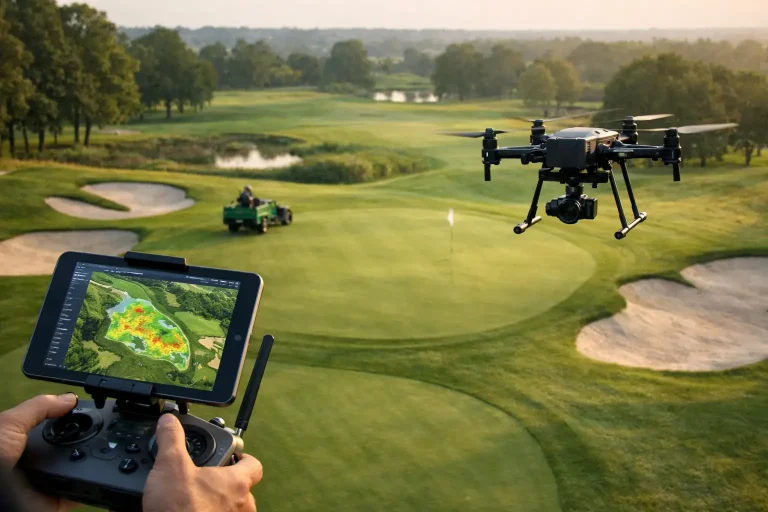
A soft area on the 7th fairway rarely stays just a soft area. It becomes a mowing issue, then a presentation issue, then a question about drainage, irrigation or surface levels. Greenkeeper drone mapping helps turn that kind of recurring guesswork into measurable evidence. Instead of relying on isolated observations from the ground, course teams can view the full picture with accurate aerial data that supports faster, better decisions.
For greenkeepers and golf course managers, the value is not in having attractive drone imagery for its own sake. The real value is seeing how the course performs as a system. Surface movement, water pathways, stressed turf, irrigation infrastructure and maintenance priorities become easier to assess when they are mapped clearly and accurately. That is where specialist drone surveying moves from a nice extra to an operational tool.
What greenkeeper drone mapping actually means
Greenkeeper drone mapping is the use of survey-grade drone data to capture, measure and visualise the golf course in a way that supports course management. Depending on the objective, this can include topographical mapping, high-resolution orthomosaics, irrigation and drainage mapping, multispectral plant health analysis and utility overlays.
The important distinction is that this is not the same as a simple aerial photo flight. A recreational or basic commercial drone image may show what the course looks like from above, but it will not necessarily provide the accuracy or structured outputs needed for professional maintenance planning. Greenkeepers need usable data, not just a better angle.
When carried out properly, drone mapping can provide centimetre-level positional accuracy. That matters when you are reviewing fall across a green surround, checking where water is likely to sit after heavy rain, planning drainage improvements or locating buried infrastructure against visible surface features.
Why it matters more on a golf course than on many other sites
A golf course is a complicated landscape. It combines playing surfaces, landscaped areas, engineered drainage, irrigation networks, paths, water bodies, bunkers, woodland margins and operational buildings across a large area. Small variations in level or moisture can have an outsized effect on playability and maintenance cost.
Traditional surveying still has a place, especially for highly specific design or construction tasks, but it can be time-intensive and expensive when broad site coverage is needed. Greenkeeper drone mapping offers a more efficient way to capture large areas quickly while still producing reliable outputs for decision-making.
It also gives course teams something they often lack – a consistent visual baseline. When the same course is mapped over time, changes become easier to identify. You are not relying on memory, fragmented notes or separate contractor reports. You have a current record of what is happening on the ground and how it is shifting.
Where drone mapping adds the most value for greenkeepers
The strongest use cases are usually practical rather than flashy. Drainage is one of the clearest examples. If certain fairways or approaches repeatedly suffer after wet weather, aerial topographical data can help reveal the underlying shape of the land and the likely route of surface water. That does not solve the issue on its own, but it puts the greenkeeping team, consultant or contractor in a stronger position to diagnose it properly.
Irrigation planning is another major area. Many courses have developed infrastructure over years, sometimes decades, and records are not always complete or easy to use. A mapped aerial base, combined with utility overlays, can make sprinkler lines, valve locations and control zones far easier to interpret. That improves planning for repairs, upgrades and day-to-day management.
Plant health analysis can also be valuable, particularly where visual symptoms appear only after stress is already affecting surface quality. Multispectral drone surveys can identify variation in turf vigour across greens, tees and fairways before those differences are obvious from ground level. That does not replace the knowledge of an experienced greenkeeper – it strengthens it by showing patterns at scale.
For project work, the benefits are equally clear. Whether the course is reviewing bunker renovation, reshaping areas, adding drainage runs or planning a new practice facility, drone mapping creates a current and measurable record of site conditions. Architects, consultants and contractors can work from clearer information, and course teams are better equipped to challenge assumptions before works begin.
The difference between imagery and actionable data
This is where buyers need to be selective. Plenty of operators can fly a drone. Far fewer can deliver outputs that integrate into real course management workflows.
Actionable data means information that supports a specific decision. An orthomosaic can help a course manager review wear patterns or route planning. A digital surface model can help identify gradients and low points. A utility overlay can support irrigation maintenance. A multispectral analysis can guide targeted turf intervention. Each output has a job to do.
If the service stops at image delivery, the operational value is limited. The strongest mapping projects begin with the question: what decisions need to be made from this data? That shapes the survey method, the accuracy required and the format in which results should be delivered.
What to expect from a professional survey process
A proper greenkeeper drone mapping project should start with scope. Not every course needs every layer of data, and not every problem requires the same survey specification. In some cases, a high-resolution visual map is enough. In others, the requirement is precise topographical modelling, drainage assessment or plant health analysis over key playing surfaces.
Once the scope is clear, the flight plan, control points and processing workflow can be set to match the level of accuracy needed. This is not just a technical detail. It affects whether the final outputs are suitable for consultants, irrigation designers, contractors or internal management teams.
After capture, the data needs to be processed into usable formats. That might include georeferenced imagery, contour models, elevation datasets, marked-up utility plans or comparative reporting between survey dates. The best providers make this practical rather than overly technical. Precision matters, but so does clarity.
Trade-offs greenkeepers should understand
Drone mapping is powerful, but it is not magic. Weather can affect flight windows and image consistency, particularly in exposed locations. Dense tree cover can limit visibility of ground features in some areas. If infrastructure is completely buried and there are no reliable records, drone data may need to be combined with other survey methods to confirm exact positions.
There is also a difference between identifying patterns and proving causation. A drone survey may show where turf stress is appearing or where water collects, but interpreting why that is happening still requires on-site expertise. Soil conditions, rootzone composition, irrigation performance and historic maintenance practices all matter.
That is why the best results come from pairing aerial intelligence with course knowledge. The drone provides scale, precision and repeatability. The greenkeeping team provides context.
Choosing a specialist rather than a general drone operator
Golf courses are not generic commercial sites. Their management priorities are different, and the data needs to reflect that. A specialist provider understands the operational pressures around playability, presentation, irrigation performance, drainage reliability and seasonal maintenance windows.
That sector knowledge shapes the survey. It affects what gets captured, how outputs are presented and which findings are likely to matter most to decision-makers. A golf course manager does not need a folder of technical files with no obvious application. They need clear visual intelligence that can support budgeting, contractor conversations, maintenance planning and strategic improvements.
This is where a specialist business such as Vantage Imagery Limited can offer a genuine advantage. The combination of advanced drone surveying, mapping accuracy and a clear understanding of golf course operations produces outputs that are far more useful than generic aerial content.
When greenkeeper drone mapping makes the strongest business case
The return is usually strongest where a course is dealing with recurring maintenance inefficiencies, incomplete infrastructure records or planned capital works. If teams are repeatedly spending time investigating the same wet areas, struggling to locate assets confidently or making improvement decisions from partial information, better mapping quickly becomes commercially sensible.
It can also improve communication beyond the greenkeeping department. Committee members, owners, consultants and contractors often understand visual evidence far more quickly than verbal explanations or handwritten plans. A clear aerial map can shorten discussions, reduce ambiguity and help projects move forward with more confidence.
For many courses, that is the real shift. Greenkeeper drone mapping is not simply about seeing the course from above. It is about giving skilled professionals a more accurate foundation for decisions that affect turf quality, maintenance efficiency and long-term investment.
The courses that benefit most are usually not chasing technology for its own sake. They are using precise aerial data to remove uncertainty, target spend where it matters and manage the golf course with a clearer view of what is actually happening on the ground.
