 Skip to main content
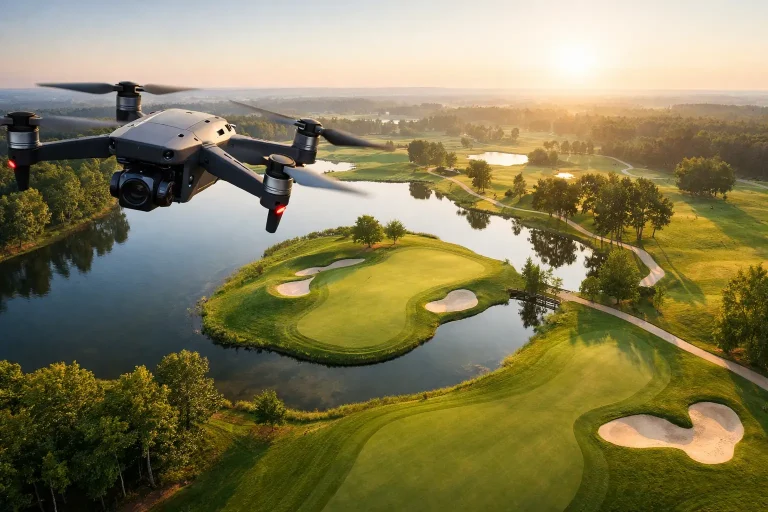
A course can look immaculate from the clubhouse terrace and still be hiding drainage failures, irrigation blind spots or wear patterns that only become obvious from above. That is where aerial photography for golf courses moves beyond marketing and becomes a practical management tool.
For course managers, owners and consultants, the real value is not simply a dramatic overhead image. It is the ability to see the entire site in context, capture conditions with consistency and turn those visuals into decisions. When done properly, aerial imagery supports presentation, planning and performance in equal measure.
Why aerial photography matters on a golf course
Golf courses are operationally complex landscapes. Fairways, greens, bunkers, rough, woodland, lakes, paths, maintenance areas and built assets all interact, and small issues in one area often have wider consequences elsewhere. Ground-level photography can document detail, but it rarely shows how those relationships play out across 18 holes.
Aerial imagery changes that perspective. It provides a complete visual record of the course at a specific point in time, making it easier to assess layout, identify pressure points and communicate issues clearly. For clubs planning capital works, reviewing maintenance priorities or presenting the course to members and visitors, that broader view has immediate commercial value.
There is also a significant difference between basic drone images and specialist aerial capture. A hobby-style flight may produce attractive pictures, but it will not necessarily deliver consistent angles, reliable coverage or outputs that can be used alongside mapping, drainage plans or irrigation data. On a managed site, quality and purpose matter.
Aerial photography for golf courses is not just promotional
Promotional imagery still has an important role. A well-shot aerial gallery can strengthen a club’s website, support membership campaigns and help event organisers understand the venue before they arrive. It can show hole character, landscape quality and the overall standard of presentation far better than a handful of ground shots.
But the strongest use case is operational. Aerial photography helps teams inspect bunker edges, monitor path condition, assess tree lines, review water hazards and understand the visual impact of agronomic or construction work. It gives decision-makers a shared reference point, which is especially useful when managers, architects, contractors and committees are discussing the same area from different perspectives.
That is often where value compounds. The same flight can create marketing imagery, a current-condition record and a base layer for wider survey or mapping work. Instead of commissioning separate visits for separate outcomes, a well-planned aerial project can support multiple business needs at once.
What good aerial capture should actually deliver
A golf course does not need more images for the sake of it. It needs imagery that is sharp, usable and captured with a clear brief.
That usually starts with coverage planning. Different sites require different approaches depending on tree density, topography, built structures, neighbouring property and the purpose of the imagery. A marketing-led shoot may favour lower-angle hero shots and golden-hour light. A maintenance-led brief may need cleaner top-down coverage with consistent altitude and overlap so features can be compared accurately.
Timing matters as well. Aerial photography taken after heavy rain will tell a very different story from imagery captured in a dry spell. That can be helpful or misleading depending on the objective. If the goal is to show winter drainage issues, poor conditions may be precisely what you want recorded. If the club needs brochure-quality visuals, a different window makes more sense.
The best results come when photography is treated as part of a wider site intelligence process rather than an isolated creative exercise. This is particularly true for golf courses, where visual information is most useful when tied to physical assets and management priorities.
Where aerial photography helps course operations
For greenkeeping and course management teams, aerial imagery is often most valuable between major projects rather than only during them. It helps establish a clear baseline before work starts, then provides a record of change over time. On courses where budgets must be justified carefully, that visual evidence can be as important as the technical findings themselves.
Drainage is a good example. Persistent wet areas can be difficult to explain in a committee meeting when the discussion is based on memory and anecdote. Overhead imagery gives structure to that conversation. It shows where water is collecting, how affected ground relates to surrounding features and whether a local issue may connect to a wider pattern across the hole.
Irrigation planning benefits in much the same way. Sprinkler locations, dry patches, shaded turf and inaccessible areas become easier to review when the course is seen as a coordinated system rather than a series of isolated problems. If that imagery is captured by a specialist provider with mapping capability, it can also support integration into irrigation or course management workflows.
Tree management is another area where aerial visuals are highly effective. They help identify encroachment, canopy density and the extent to which vegetation is affecting airflow, shade or strategic play corridors. From a course presentation and agronomy perspective, that wider visibility is difficult to replicate on foot.
The difference between photography and survey-grade outputs
This is where many buyers need clarity. Aerial photography for golf courses can range from purely visual content to technically processed outputs that support measurement and planning. Both have value, but they are not the same service.
Photography focuses on image quality, composition and coverage. It is ideal for promotion, reporting and visual review. Survey-grade capture goes further, using structured flight planning and photogrammetric processing to produce orthomosaics, topographical context and measurable spatial data.
In practice, many golf courses need a combination. A club may want polished aerial photographs for marketing while also requiring accurate mapping for drainage works, bunker renovation or irrigation upgrades. Treating these as connected services often produces better results, because the imagery is captured with both presentation and operational use in mind.
That is where specialist providers stand apart from general drone operators. The issue is not simply whether a pilot can fly and take pictures. It is whether they understand golf-course constraints, know which outputs will support real management decisions and can deliver data with sufficient precision to be useful after the shoot is over.
Choosing the right provider for aerial photography for golf courses
If you are commissioning aerial work for a golf site, ask a straightforward question at the outset: what decisions should this imagery help us make? That answer shapes everything from flight timing to output format.
A provider with genuine golf-sector experience will ask better questions. They will want to know whether you are documenting drainage issues, planning reconstruction, reviewing turf stress, producing member communications or building a promotional library. They will also understand site access, operational constraints and the need to work safely around live course conditions.
Certification and compliance should be taken as standard, not treated as a premium extra. So should image quality, dependable turnaround and a clear explanation of what will be delivered. The more important differentiator is whether the provider can align photography with wider surveying and mapping capability when the brief demands it.
That matters because a course rarely stands still. Projects evolve, budgets shift and operational questions change through the season. A specialist partner can provide aerial imagery that still has value months later because it fits into a broader record of the site. For many clubs, that long-term usability is more important than a one-off set of attractive images.
Vantage Imagery Limited works in this space with a clear focus on golf environments, combining aerial photography with precision mapping and data-led outputs that support real course decisions.
Commercial value, not just visual appeal
The strongest case for aerial imagery is not that it looks impressive, although it often does. The strongest case is that it improves visibility across an asset that is expensive to maintain and difficult to assess from the ground.
For owners and managers, that can mean better planning and clearer communication. For greenkeepers and consultants, it can mean faster identification of site issues and a more accurate basis for recommending action. For clubs investing in upgrades, it can mean having before-and-after evidence that shows progress properly.
There are trade-offs, of course. Aerial photography is not a substitute for agronomic expertise, drainage investigation or topographical survey where those are specifically required. It is one layer of intelligence, albeit a highly useful one. Its value depends on the brief, the capture quality and how effectively the outputs are used afterwards.
When those elements are aligned, aerial imagery becomes far more than a marketing asset. It becomes a practical way to see the course clearly, manage it with greater confidence and support decisions with evidence rather than assumption.
The best aerial photography gives you more than a better view – it gives you a better basis for action.
