 Skip to main content
A green that looks fine from ground level can tell a very different story from 80 metres up. That is why course condition imagery examples matter – not as attractive aerial shots, but as working evidence that helps course managers, greenkeepers and consultants make faster, better-informed decisions.
For golf facilities, imagery only becomes valuable when it reveals something actionable. A photograph of a fairway is easy to produce. A mapped image set that shows persistent wet ground, thinning turf, traffic damage or irrigation inconsistency is far more useful. The difference is not visual quality alone. It is whether the imagery supports maintenance planning, budget decisions and on-course priorities.
What good course condition imagery examples actually show
The best course condition imagery examples do not try to show everything at once. They isolate a condition, make it visible and give the management team a clearer basis for action. In practice, that usually means combining standard aerial imagery with mapping outputs, annotated comparisons or plant-health data rather than relying on a single photograph.
A useful image should answer a practical question. Where is water sitting after rainfall? Which approaches are taking the most traffic? Are weak areas random, or do they follow an irrigation line, a drainage run or a soil boundary? When imagery is collected with survey-grade discipline, those questions become much easier to answer.
Example 1 – Surface water and drainage weak points
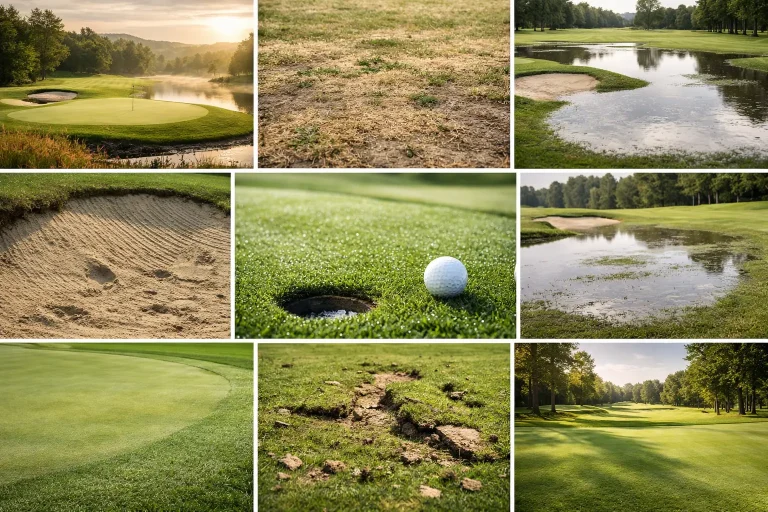
One of the strongest uses of aerial course imagery is identifying where water is collecting and how that pattern moves across playing surfaces. After rainfall, drone imagery can reveal standing water on fairways, dark saturated bands on approaches and soft ground around low points that may not be obvious from a buggy route inspection alone.
This matters because drainage problems are rarely isolated to the wet patch itself. The image often shows the wider context – fall lines, surrounding bunkers, nearby tree belts, compacted traffic zones or drainage outfalls that are no longer performing as intended. For a club planning drainage upgrades, that wider visual pattern is often more useful than a verbal description from several team members seeing the issue from different angles.
The trade-off is timing. If imagery is captured long after rainfall, the clearest evidence may have gone. Condition imagery works best when planned around the problem you want to assess.
Example 2 – Turf stress on greens and surrounds
When greens begin to lose consistency, standard ground inspection still matters, but aerial imagery can add a layer of pattern recognition that is difficult to achieve on foot. In course condition imagery examples focused on turf stress, the useful signs are often tonal variation, patchiness, weak rings, edge decline and uneven colour across the surface.
If multispectral analysis is used, these differences become more measurable. Areas of reduced plant vigour can be identified before visible decline becomes severe enough to affect presentation or playability. That gives the turf team earlier evidence for reviewing irrigation performance, soil conditions, disease pressure or localised dry patch.
It depends, though, on what question you are trying to answer. If the issue is disease diagnosis, imagery supports the process but does not replace agronomic inspection. If the issue is pattern recognition across multiple greens, aerial data becomes much more powerful.
Example 3 – Wear patterns around tees, paths and pinch points
Every course has high-traffic areas that deteriorate faster than the rest of the site. Tees, walk-off points, crossing routes, buggy exits and narrow fairway entries often suffer gradual wear that builds over a season. From ground level, that wear can feel routine. From above, it often appears as a clear operational pattern.
This is where imagery becomes commercially useful. Instead of treating symptoms as they appear, clubs can see where traffic is repeatedly concentrated and adjust route management, rope lines, path placement or surface reinforcement. In some cases, the imagery supports capital planning by showing that a path extension or redesign is no longer optional.
These examples are especially valuable when compared over time. A single image shows existing damage. Repeated capture shows whether the damage is seasonal, worsening or simply shifting to a nearby area after an intervention.
Example 4 – Irrigation inconsistency across playing surfaces
Dry streaks, overwatered sections and uneven coverage are common frustrations on golf courses, particularly where systems have aged, layouts have changed or records are incomplete. A good course condition imagery example in this category will show recurring dry or stressed zones that align with sprinkler coverage gaps, pressure issues or uneven application.
This is where precision mapping moves beyond visual appeal. When imagery is aligned with irrigation layouts, heads, valves and control zones, a club can investigate causes with far more confidence. You are no longer working from a rough impression that one side of a green always seems weaker. You can see the shape, extent and repeatability of the issue.
For irrigation specialists and course managers, this helps prioritise remedial work. Full system replacement may not be the immediate answer. Sometimes the imagery points to local adjustments, blocked nozzles, poor overlap or drainage interaction rather than a system-wide fault.
Example 5 – Bunker performance and sand contamination
Bunkers are another area where aerial imagery can be more informative than people expect. Condition imagery examples here often show washout patterns, edge erosion, contaminated sand zones, inconsistent moisture retention and the spread of vegetation encroachment around bunker margins.
This matters because bunker problems are rarely just presentation problems. They affect labour demand, drainage performance, player experience and renovation budgets. Viewed from above, clubs can assess which bunkers repeatedly fail after weather events, which ones have surrounding ground directing runoff into the sand, and which edges are breaking down due to foot traffic or design wear.
The limitation is detail at very small scale. A drone image may indicate contamination or wash movement, but it should still sit alongside physical inspection. The value lies in seeing the bunker within its surrounding landform, not replacing close-up assessment.
Example 6 – Tree shading, canopy influence and weak turf corridors
Tree management can be contentious on golf courses because the discussion often mixes strategy, aesthetics and turf performance. Imagery helps separate opinion from evidence. In course condition imagery examples linked to tree impact, the useful output is not simply a picture of woodland edges. It is a clear visual relationship between canopy position, shading, moisture retention, airflow restriction and weak turf beneath or beside the affected zone.
This is especially helpful on greens surrounds, tees and narrow corridors where poor light and restricted air movement gradually reduce turf quality. Aerial imagery, particularly when repeated across seasons, can show whether decline tracks shade patterns or whether the cause lies elsewhere.
For committees and consultants, that evidence can make difficult management decisions easier to explain. It turns a subjective debate into a documented site condition issue.
Example 7 – Project tracking before and after remedial works
Some of the most useful examples are comparative rather than diagnostic. Before-and-after imagery of drainage installation, bunker renovation, tee rebuilds, path works or turf recovery gives clubs a reliable visual record of what changed and whether it delivered the intended result.
This is valuable operationally and commercially. Internally, it helps justify spend and evaluate outcomes. Externally, it provides evidence for stakeholders, committees and consultants who want to see measurable improvement rather than broad claims. For specialist survey providers such as Vantage Imagery Limited, this is where imagery becomes part of a wider decision-making system rather than a one-off exercise.
How to judge whether an imagery example is actually useful
Not all aerial outputs deserve attention. If an image looks impressive but does not support a decision, it has limited practical value. The best examples are precise, well-timed and linked to a specific maintenance or planning issue.
Look first at clarity of purpose. Was the imagery captured to investigate drainage, turf health, wear, irrigation or construction progress? If the answer is vague, the output usually will be too. Next, consider scale and context. Close detail is important, but so is seeing the issue in relation to surrounding features such as slopes, paths, infrastructure and play lines.
Finally, accuracy matters. For clubs using imagery to support contractor discussions, overlay utility plans or align works with existing mapping, survey-grade positioning is far more valuable than general aerial photography. Better data reduces guesswork, and less guesswork usually means less wasted spend.
Why these examples matter to golf operations
The real value of course condition imagery is not that it shows the course from above. It is that it helps decision-makers see condition issues earlier, explain them more clearly and respond with greater precision. For golf operations, that can mean targeted drainage work instead of blanket disruption, smarter irrigation adjustments instead of higher water use, and better evidence when planning budgets or reporting to committees.
Imagery is not a substitute for greenkeeping expertise, agronomy or practical site knowledge. It is a tool that sharpens those disciplines when the data is captured properly and used for the right purpose. The strongest results come when imagery is treated as working intelligence, not marketing material.
If you are reviewing course condition imagery examples, the key question is simple: does this help the next decision become clearer? If it does, the imagery is doing its job.
