 Skip to main content
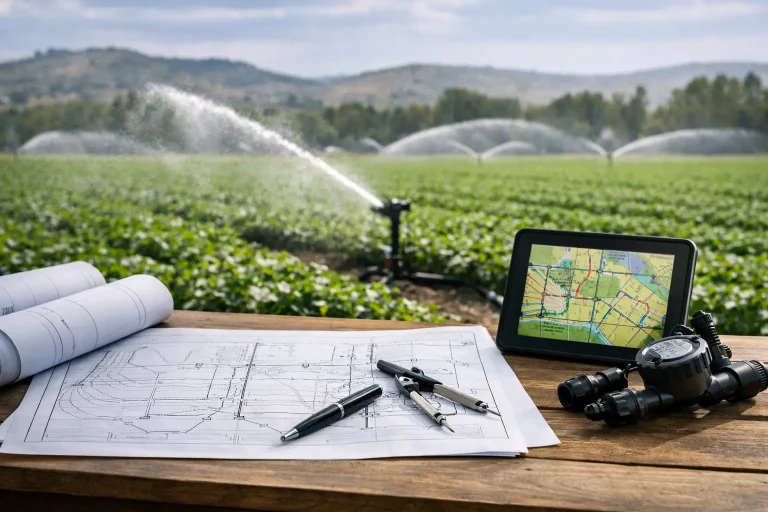
A valve box that is not where the drawing says it is can turn a simple repair into a long, expensive search. That is exactly why irrigation as laid plans matter. For golf courses, where buried infrastructure affects playing surfaces, labour planning and water efficiency, relying on outdated sketches or inherited knowledge is a risk that shows up in wasted time, unnecessary excavation and avoidable system faults.
An irrigation network is one of the most operationally critical assets on a course, yet it is often one of the least clearly documented. Original design drawings may exist, but they do not always reflect what was actually installed. Pipe routes can shift during construction. Heads may be relocated years later. Control wiring can be altered during repairs or phased upgrades. Over time, the gap between the intended layout and the real-world network becomes wider.
What irrigation as laid plans actually show
Irrigation as laid plans are a verified record of the system as installed, not just as designed. That distinction matters. A design plan shows intent. An as laid plan shows what is physically in the ground, where assets sit in relation to fixed site features, and how the system connects across the course.
For a golf club, that usually includes sprinkler head positions, valve locations, pipe runs, control routes, tanks, pump stations and other supporting infrastructure. When prepared properly, these plans give management and maintenance teams a dependable visual reference that can support both day-to-day decisions and long-term capital planning.
The value is not simply in having a drawing. It is in having a reliable, spatially accurate record that reflects current conditions. If that accuracy is missing, the plan becomes little more than a rough guide.
Why design drawings are not enough
Many clubs assume their existing irrigation plans are good enough because they hold a PDF from the original installation or a consultant’s archive. Sometimes they are usable. Often they are not.
Installation changes are common on live projects. Contractors adjust routes to avoid obstacles, ground conditions or legacy services. Later, emergency repairs may create undocumented diversions. A redevelopment programme might replace sections rather than whole networks, leaving a patchwork of old and new infrastructure. In each case, the design drawing becomes less accurate.
That matters most when the system starts costing money in avoidable ways. A leaking line that takes hours to find, repeated head failures in one area, or uncertainty around which valves serve which holes all point to the same issue – poor visibility of the asset base.
This is where survey-grade mapping changes the conversation. Instead of working from assumptions, the club works from evidence.
The operational value on a golf course
For course managers and greenkeeping teams, accurate irrigation records reduce friction across a wide range of tasks. Fault finding becomes faster because teams know where to start. Repair work becomes more controlled because excavation can be targeted. Seasonal planning improves because network zones, pressure relationships and asset locations are easier to understand.
There is also a wider management benefit. Irrigation is not a standalone system. It overlaps with drainage, path construction, bunker renovation, tree works, utility routes and course redevelopment. When buried infrastructure is clearly mapped, project planning becomes safer and more efficient.
That is particularly relevant on established courses where infrastructure has evolved over decades. Institutional knowledge can be valuable, but it is fragile. Staff changes, contractor turnover and incomplete handovers can quickly erode what was previously “known” about the site. A current as laid plan creates continuity.
Irrigation as laid plans and capital planning
One of the most overlooked uses of irrigation as laid plans is in phased investment planning. Many clubs are not replacing a full system in one go. They are upgrading pump stations, adding decoder systems, replacing problematic laterals or improving coverage in selected areas over time.
Without accurate baseline mapping, those investments can be harder to scope and easier to misprice. Consultants and contractors need confidence in what is already in place. If they are working from partial records, contingency costs rise and recommendations can become more conservative.
With a verified asset map, clubs can assess what can be retained, what needs replacement and where the highest-risk components sit. That supports more informed budgeting and better sequencing of works. It also helps when comparing tenders, because each contractor is pricing against a clearer understanding of the existing network.
Where drone mapping fits in
Drone surveying does not replace every ground-based check, but it dramatically improves the quality and usability of irrigation mapping when combined with the right workflow. High-resolution aerial data provides an accurate spatial framework for the course, capturing fairways, greens, paths, water bodies, tree lines and built features in a way that is immediately useful.
When that aerial framework is tied to centimetre-accurate mapping outputs, buried irrigation assets can be overlaid in their true site context. The result is far more practical than a standalone utility sketch. Maintenance teams can see infrastructure in relation to the surfaces they manage every day.
For golf environments, that context is especially valuable. An irrigation head is not just a coordinate. It sits on a green surround, beside a bunker edge, near a path crossing or within an area known for dry patch. Mapping that relationship properly improves decision-making.
Specialist providers can also integrate irrigation records with topographical data, drainage mapping and multispectral analysis. That creates a stronger operational picture, particularly where turf performance issues may be linked to water distribution, compaction, runoff or system inconsistency.
Accuracy is not a luxury
There is a temptation to treat mapping precision as a nice extra, particularly when clubs are balancing maintenance costs carefully. In practice, accuracy is what makes the plan useful.
If a valve is shown several metres from its real location, the drawing may still look professional, but it will not save time on the ground. If pipe routes are approximate, excavation risk remains. If updates are not controlled, the plan starts drifting out of date from the moment it is issued.
That is why precision-led surveying matters. Good mapping should support real operational use, not just compliance files or committee presentations. The goal is actionable asset intelligence – something a course manager, irrigation contractor or consultant can trust when work needs to happen quickly.
When to update or create as laid plans
Some clubs need a new irrigation as laid plan because they have never had one. Others need an updated version because the existing record no longer reflects reality. A few common triggers stand out.
A system replacement or major upgrade is an obvious one. So is repeated difficulty tracing faults, uncertainty over network layout, or planned construction works near buried services. Changes in management can also prompt action, especially where asset knowledge has been held informally rather than documented clearly.
There is no single rule on timing. If the current records are inaccurate enough to slow repairs or complicate planning, the need is already there. Waiting usually means more reactive cost later.
What good output looks like
A useful as laid plan should be clear, current and easy to apply in the field. That means accurate positioning, consistent labelling and outputs that suit how the club actually works. For some teams, that may mean layered digital mapping for consultant and contractor use. For others, it may also include straightforward visuals that help the maintenance team identify zones and assets quickly.
The best outputs do not bury the user in data for the sake of it. They organise information so that different stakeholders can act on it. A course manager may need a strategic overview for budgeting, while a technician needs exact asset positions. Both should be supported.
This is where specialist understanding makes a difference. Mapping a golf course well is not just about collecting coordinates. It is about knowing which features matter operationally and presenting them in a format that supports irrigation management, course conditioning and project delivery.
A stronger foundation for better decisions
Irrigation systems are expensive to install, expensive to replace and expensive to mismanage. Yet many of the avoidable costs around them come back to one simple issue – poor information. When a club lacks a dependable record of what is in the ground, every repair, upgrade and planning discussion becomes harder than it needs to be.
Accurate as laid plans do not solve every irrigation problem. Water supply, pressure balance, ageing components and design limitations still need attention. But they give clubs a far stronger starting point. They reduce guesswork, support faster maintenance and create confidence when investment decisions are on the table.
For any golf facility serious about managing infrastructure professionally, verified irrigation mapping is not paperwork. It is part of the operating system. And once you have that level of clarity on the course, better decisions tend to follow.
