 Skip to main content
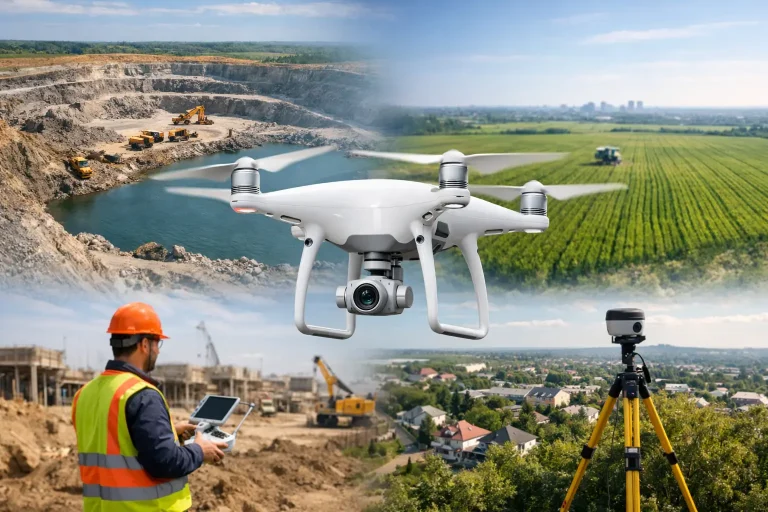
A course manager trying to trace recurring wet patches, a contractor needing weekly progress records, and a facilities team checking a large roof all face the same problem: they need accurate site intelligence quickly. That is why the top drone survey use cases are no longer limited to marketing imagery or one-off aerial photos. For commercial sites, drones now deliver survey-grade data that supports planning, maintenance, compliance and day-to-day decision-making.
The real value is not the aircraft itself. It is the quality of the output and how well that data can be used on the ground. When a survey is properly planned, controlled and processed, drone data can provide centimetre-accurate mapping, clear visual records and analytical layers that help teams act with more confidence.
What makes drone surveys commercially useful
A drone survey becomes commercially valuable when it answers a specific operational question. Where are the drainage runs? How much stockpile volume is on site? Which greens are showing early signs of turf stress? Is that roof defect isolated, or part of a wider maintenance issue?
This is where many buyers separate specialist providers from generic drone operators. High-quality survey work is not just about flying. It depends on flight planning, control points where needed, processing standards, and outputs that fit how the client actually works. Orthomosaics, elevation models, topographical surfaces and utility overlays only matter if they improve a decision, reduce uncertainty or save time on site.
Top drone survey use cases in golf course management
Golf is one of the clearest examples of where drone surveying moves from interesting imagery to practical operational value. Large, varied landscapes are difficult to assess consistently from the ground, and many of the most expensive issues – irrigation inefficiency, drainage failure, turf decline and hidden infrastructure conflicts – develop gradually.
Course mapping and topographical surveys
For golf clubs, detailed course mapping is often the foundation for better management. A drone-based topographical survey can capture fairways, greens, bunkers, paths, water features and surrounding terrain with a level of detail that is difficult to match through manual site review alone.
This is particularly useful when planning redevelopment work, bunker changes, tee extensions or drainage improvements. Accurate contours and surface models help consultants and contractors understand the land before work starts. It can also reduce the risk of design decisions being based on outdated drawings or incomplete ground observations.
The trade-off is straightforward. If dense tree cover, heavy canopy or highly complex built features are the main issue, a combined approach may be more appropriate. In some situations, drone data works best alongside ground survey rather than replacing it entirely.
Irrigation and drainage mapping
Many golf sites have irrigation and drainage infrastructure that has evolved over years or decades, often with incomplete records. That creates inefficiency fast. If teams are relying on memory, partial plans or trial and error, faults take longer to locate and maintenance becomes harder to prioritise.
Drone mapping can help create a clear spatial record of visible course features and support utility overlays that bring existing infrastructure data into a more usable format. For irrigation specialists and course managers, that means better visibility of head locations, pipe runs, drainage lines and problem areas.
This use case matters because water management is both a performance issue and a cost issue. Better mapping supports smarter repair planning, more accurate upgrades and stronger coordination between contractors, greenkeeping teams and consultants.
Multispectral turf health analysis
Not every turf issue is visible early at ground level. Stress can be developing before discolouration becomes obvious to staff or players. Multispectral surveys help identify variation in plant health across greens, approaches, fairways and managed rough, allowing teams to target inspections and interventions more precisely.
This is not a magic answer to every agronomic problem. Multispectral data needs correct interpretation, and weather, seasonality and timing all affect results. But when used properly, it can highlight patterns that would otherwise be missed, especially across larger sites where walking every area in detail is unrealistic.
For clubs balancing presentation, playability and input costs, that early visibility can be commercially significant.
Top drone survey use cases on construction sites
Construction teams usually care about speed, accuracy and accountability. Drone surveys support all three, especially on projects where sites are changing every week.
Progress tracking and stakeholder reporting
One of the strongest use cases in construction is repeatable progress monitoring. Regular aerial captures create a visual record of how a site changes over time, which is useful for project managers, clients, funders and subcontractors alike.
The advantage is not just better photographs. Consistent aerial viewpoints and mapped outputs help teams compare programme progress against expectations, identify access constraints and document site conditions at specific dates. That can help with reporting and, in some cases, with dispute avoidance.
Of course, not every project needs the same frequency. Weekly flights may suit a fast-moving commercial build, while monthly surveys are enough for longer programmes. The right schedule depends on project complexity, budget and reporting needs.
Volumetric measurements and earthworks management
Where materials are moved, stored or reshaped, drone survey data can provide quick and repeatable volume calculations. This is widely used for stockpiles, cut-and-fill analysis and general earthworks tracking.
Compared with traditional methods, the efficiency gain can be substantial, particularly on large or awkward sites. Teams can measure more often, spot discrepancies earlier and improve forecasting around material use and haulage.
As ever, context matters. If a stockpile is heavily obscured, tightly confined or surrounded by active plant movements, data capture needs careful planning. Accuracy also depends on sound processing and site conditions, not just the drone flight itself.
Property and facilities use cases with immediate value
Outside golf and construction, many property owners and facilities managers are turning to drone surveys for one reason: access. Large roofs, elevated façades and hard-to-reach assets are expensive and disruptive to inspect using traditional methods.
Roof inspections and condition assessment
A high-resolution drone roof survey can reveal slipped coverings, blocked outlets, ponding, flashing defects and localised wear without the delay and cost of scaffolding for an initial review. For estates, commercial buildings and larger facilities portfolios, that means problems can be identified and prioritised faster.
This does not remove the need for hands-on inspection in every case. If a defect requires intrusive investigation or close material testing, a physical visit is still needed. But drone surveys are highly effective for early assessment, maintenance planning and documenting condition over time.
Asset records and estate mapping
For business parks, schools, sports facilities and multi-building sites, drone mapping creates an up-to-date visual record that can support maintenance, planning and communication across teams. Boundaries, access roads, parking areas, drainage features, roof layouts and open land can all be recorded in a single coherent dataset.
That is especially helpful where existing plans are fragmented or outdated. A current mapped view reduces ambiguity and gives facilities teams a better baseline for future works.
Why the best use cases are the ones tied to a decision
The most effective drone survey projects start with a business need, not a flight plan. Buyers often get the strongest return when they define the decision first. Are you planning drainage upgrades? Verifying contractor progress? Assessing roof condition before a maintenance budget is set? Reviewing turf health before symptoms become widespread?
That focus shapes everything else – the sensor choice, flight pattern, output format and reporting detail. It also prevents a common problem: collecting large amounts of data that look impressive but do not translate into action.
For specialist environments such as golf courses, this is where an experienced provider adds real value. Precision matters, but relevance matters just as much. Data should fit the operational workflow, whether that means supporting course redevelopment, integrating with irrigation planning or helping a management team present evidence-backed priorities to a committee.
Choosing the right drone survey use case for your site
If you are assessing where drones fit into your operation, start by looking for expensive uncertainty. That is usually the best place to begin. Hidden drainage issues, unclear site progress, poor asset visibility and reactive maintenance all create avoidable cost.
The strongest use cases are not always the most complex. Sometimes a straightforward orthomosaic and topographical model provide the clearest commercial benefit. In other situations, repeat surveys or multispectral analysis justify themselves because the site changes constantly or the cost of missing an issue is high.
A good survey should give you more than imagery. It should give you a clearer basis for action, whether that is planning works, allocating budget, reducing risk or improving day-to-day management. That is where drone surveying earns its place – not as a novelty, but as a practical source of precision-led insight.
