 Skip to main content
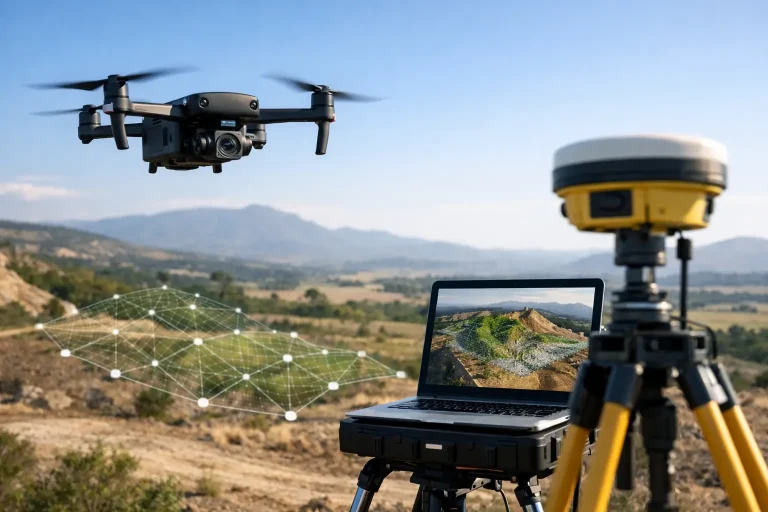
A single drone flight over a golf course can produce far more than a set of attractive aerial photographs. With the right flight planning, ground control and processing, that same flight can generate accurate mapping, terrain models and measurable site data. That is what is drone photogrammetry in practical terms – a method of turning overlapping aerial images into reliable spatial information that supports real operational decisions.
For golf clubs, estates, construction sites and commercial properties, the value lies in precision. You are not paying for a bird’s-eye view alone. You are investing in data that can help identify drainage routes, measure stockpiles, map irrigation infrastructure, assess surface levels or track changes over time.
What is drone photogrammetry and how does it work?
Drone photogrammetry is the process of using a drone to capture a large number of overlapping images, then processing those images with specialist software to create accurate maps and 3D models. The software identifies common points across multiple photographs and calculates their position in space. From that, it reconstructs the surface and features of the site.
The principle is not new. Photogrammetry has been used in surveying and mapping for decades. What has changed is the speed, accessibility and quality now possible through advanced drone platforms, high-resolution sensors and survey-grade processing workflows.
In practice, the workflow is straightforward in concept but technical in execution. A drone flies a planned route over a site, capturing images at set intervals with sufficient overlap. Those images are then processed to create outputs such as orthomosaics, digital surface models, 3D point clouds and contour data. If the project requires higher positional confidence, survey control points and RTK or PPK correction methods are used to improve accuracy.
That last point matters. Anyone can send up a drone and take photographs. Photogrammetry becomes commercially useful when the data is captured and processed to a standard that supports measurement, planning and decision-making.
Why businesses use drone photogrammetry
The real appeal of drone photogrammetry is not the technology itself. It is the combination of coverage, speed and usable output. Traditional ground survey remains essential in many settings, particularly where dense vegetation, hidden services or legal boundary definition are involved. But for large outdoor spaces and visible surface features, drone-based capture can be faster and more cost-effective.
On a golf course, for example, photogrammetry can provide a clear, current overview of fairways, bunkers, paths, water features and built assets. That information becomes useful when planning drainage work, refining irrigation layouts, monitoring wear patterns or reviewing course changes. Rather than working from outdated drawings or fragmented records, teams can reference a consistent aerial dataset.
The same logic applies on construction sites. Managers use drone photogrammetry to monitor progress, compare site conditions over time and improve communication between stakeholders. Roof inspections benefit too, especially where access is difficult or disruptive. The images are valuable, but the measured model often carries more operational value than the photography alone.
The outputs that make drone photogrammetry useful
One reason the term can feel abstract is that it covers several different outputs. The choice depends on what the client needs to know.
An orthomosaic is often the most immediately useful result. This is a high-resolution aerial image that has been corrected for perspective and stitched together so it can be used like a map. Distances, areas and visible site features can then be reviewed with far greater confidence than from a standard photograph.
A digital surface model adds elevation data. That helps with understanding slopes, runoff patterns, mounds, cut-and-fill requirements or surface behaviour after rainfall. On a golf course, this can inform drainage planning, construction work and general course management.
A 3D point cloud or mesh model provides a more detailed representation of the site in three dimensions. This can be useful for visualisation, design review or volumetric measurement. In some projects, contour mapping is the preferred output because it integrates more easily into design and planning workflows.
The key point is that photogrammetry is not one file type or one deliverable. It is a data capture method that can support several outcomes.
How accurate is drone photogrammetry?
Accuracy is the first serious question commercial clients should ask, because the answer is always project-specific. Drone photogrammetry can achieve excellent results, including centimetre-level accuracy, but that does not happen automatically.
Accuracy depends on the drone platform, camera quality, flight altitude, image overlap, lighting conditions, control points, correction methods and the way the dataset is processed. Site conditions matter as well. Open ground with clear, visible features is generally more suitable than dense woodland, reflective surfaces or areas with repetitive texture.
This is where professional survey design makes a difference. If the goal is broad visual mapping, the tolerances may be less demanding. If the output will inform construction planning, irrigation upgrades or drainage design, the methodology needs to match that requirement. A provider should be clear about expected accuracy and equally clear about the limitations.
That is also why photogrammetry is not a blanket replacement for every survey method. Ground survey, GNSS, laser scanning and utility detection each have their place. The strongest results often come from combining methods rather than treating one technology as the answer to everything.
What drone photogrammetry is especially good at
Drone photogrammetry performs best when a site needs fast, repeatable capture of visible surface information over a relatively large area. That makes it particularly effective for golf courses, sports venues, estates, development land, construction sites and commercial roofs.
For golf course management, one of the biggest advantages is visibility. Teams can see the site as a connected whole rather than as isolated features on the ground. Greens, bunkers, drainage lines, paths, ponds and tree groups can all be mapped in relation to one another. This makes planning more precise and helps different contractors or consultants work from the same baseline information.
It is also highly effective for change detection. If the same area is surveyed at intervals, managers can compare condition, progress or wear over time. That may support renovation projects, drainage investigations or capital planning. When aerial data is integrated into wider operational systems, it becomes even more useful.
Where drone photogrammetry has limits
The strongest service providers are honest about trade-offs. Photogrammetry records what the camera can see. It does not see through dense canopy, standing water, roof coverings or the ground itself. If you need to locate buried utilities, confirm subsurface conditions or capture hidden structural details, other survey methods will still be required.
Weather can also affect results. Strong winds influence flight stability, while harsh shadow, glare or low-texture surfaces can reduce image quality and processing confidence. Timing matters more than many clients realise.
There is also a difference between a visually impressive model and a dependable survey output. A colourful 3D rendering might look convincing, but if the capture method was weak, the data may not be suitable for measurement. Commercial users should always focus on the intended decision the data will support.
What to look for in a drone photogrammetry provider
If you are commissioning a project, the important question is not simply whether a supplier offers photogrammetry. It is whether they can deliver survey-grade outputs that are useful in your working environment.
Look for a provider that understands your sector and asks practical questions about what you need the data for. A golf course survey for irrigation planning is not the same as a roof inspection or a construction progress report. The flight plan, control strategy and output format should reflect the job, not a one-size-fits-all package.
You should also expect clarity around accuracy, deliverables, turnaround times and operational constraints. Certified drone operations, appropriate permissions and safe flight procedures are not extras. They are part of delivering professional work with minimal disruption.
For specialist environments such as golf, sector knowledge is particularly valuable. A technically capable provider who also understands course infrastructure, playability, drainage pressure points and maintenance workflows can produce data that is far more actionable. That is where a specialist partner such as Vantage Imagery Limited adds clear value.
What is drone photogrammetry really worth?
Its value comes down to better decisions made sooner. When site teams can see accurate conditions, measure features with confidence and track change over time, planning improves. Errors reduce, communication gets easier and capital work is based on current information rather than assumption.
That does not mean every site needs a full photogrammetry survey. In some cases, straightforward aerial imagery is enough. In others, photogrammetry works best as part of a wider package that includes topographical data, utility overlays or multispectral analysis. It depends on the problem you are trying to solve.
If you are responsible for managing land, assets or infrastructure, that is the most useful way to think about it. Drone photogrammetry is not just a modern way to take pictures. It is a precision-led method of turning aerial capture into practical intelligence, and when it is done properly, that intelligence gives you a stronger basis for every next move.
