 Skip to main content
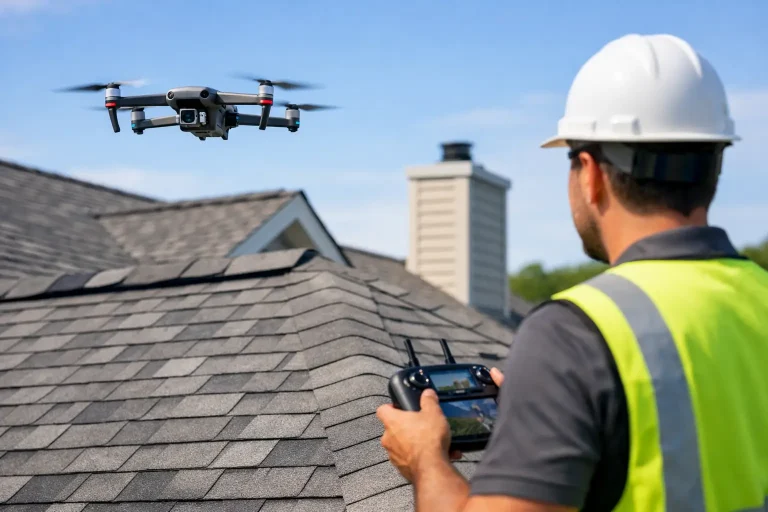
A leaking roof rarely announces itself politely. By the time water marks appear on ceilings, insulation is damp or a tenant has raised a complaint, the real issue is often sitting higher up – out of sight, awkward to reach and expensive to ignore. That is exactly why use drones for roof surveys has become a practical question for property managers, facilities teams and commercial asset owners who need clear answers quickly.
Traditional roof inspection methods still have their place, but they often involve compromise. You may need scaffolding, powered access, ladders, multiple site visits or a contractor physically walking the roof. That can increase cost, add delay and create avoidable risk, especially on large, ageing or fragile roof structures. Drone surveys change that equation by giving you a fast, high-resolution view of the roof from multiple angles without sending people straight into a hazardous environment.
Why use drones for roof surveys instead of traditional access?
The strongest case for drones is not novelty. It is better decision-making. A properly planned drone roof survey can capture detailed imagery of coverings, flashings, gutters, parapets, outlets, rooflights, plant areas and other hard-to-access elements in a fraction of the time required for conventional access methods.
For commercial buildings, that speed matters. If a site is operational, the less disruption you create, the better. A drone operator can often assess roof condition with minimal interruption to staff, customers, contractors or residents. On sites where access equipment would affect traffic flow, parking, loading bays or public areas, that is a significant operational benefit.
There is also a safety argument that is difficult to ignore. Working at height remains one of the biggest risks in inspection and maintenance activity. Using a drone does not remove every risk from a project, but it can reduce the need for immediate physical access in the early inspection stage. That means fewer assumptions, fewer unnecessary climbs and a clearer basis for deciding whether hands-on investigation is actually required.
The real value is in the detail
A good roof survey is not simply a collection of aerial photographs. The value comes from capturing usable visual intelligence that helps you identify defects, prioritise repairs and plan maintenance with confidence.
Modern drone platforms can gather high-resolution imagery that reveals slipped tiles, cracked slates, failed flashing details, blocked gutters, ponding, membrane deterioration and signs of weather damage. On flat roofs, where issues are not always obvious from ground level, overhead imagery is particularly useful because it shows drainage patterns, surface wear and localised defects in context.
This wider perspective matters. A close-up image might show a cracked detail around a penetration, but without a broader view you may miss the fact that nearby drainage is poor, vegetation is collecting in outlets or the defect is part of a larger pattern across the roof. Drone surveys make it easier to understand both the individual fault and the surrounding conditions.
For larger estates, industrial buildings, schools, hospitality sites and clubhouses, that can save a great deal of time. Instead of inspecting one isolated problem at a time, facilities teams can assess the roof as a complete asset.
Faster surveys, better planning
Roof problems are rarely just technical. They are budget decisions, scheduling decisions and risk decisions. The sooner you know what you are dealing with, the sooner you can organise the right response.
Drone surveys support this by shortening the gap between concern and clarity. If there has been storm damage, you can get a rapid visual assessment. If a roof is due for maintenance planning, you can build that plan around current conditions rather than guesswork. If a contractor has completed repairs, post-works imagery can provide a useful visual record.
That is especially helpful where multiple stakeholders are involved. Survey imagery gives property owners, contractors, insurers and management teams a shared point of reference. Instead of relying on verbal descriptions such as “wear around the edge” or “damage near the plant”, you have a visual record that can be reviewed and discussed objectively.
This tends to improve the quality of maintenance decisions. Minor defects can be picked up before they become major failures, and budgets can be directed towards the areas that genuinely need intervention first.
Why use drones for roof surveys on difficult or fragile structures?
Some roofs are straightforward. Many are not. Older buildings, large commercial units, steep pitches, awkward geometry, restricted access zones and fragile roof materials all make physical inspection more complicated.
In these cases, drones offer a clear advantage because they can inspect areas that are unsafe or impractical to walk on. That includes roofs with suspected structural weakness, brittle materials, limited edge protection or layouts that would require extensive temporary access arrangements.
This does not mean a drone replaces every other survey method. If a roof requires intrusive testing, moisture analysis beneath the surface or close physical examination of a construction detail, a hands-on inspection may still be necessary. The point is that drone data helps you decide whether that next step is justified, and where it should be focused.
That targeted approach is more efficient than sending teams onto a roof with limited prior visibility. You reduce wasted time and improve the quality of follow-up work because the problem areas have already been identified.
A stronger record for maintenance and compliance
One of the most underrated benefits of drone roof surveys is the quality of documentation. Commercial property management depends on records – not just for maintenance planning, but also for reporting, contractor management, insurance evidence and asset lifecycle tracking.
Drone imagery creates a time-stamped visual record of roof condition at a specific point in time. That is useful if you want to monitor deterioration, compare seasonal changes, assess storm impact or verify whether a known issue has worsened.
For facilities teams responsible for multiple buildings, this is a practical advantage rather than a cosmetic one. Standardised visual records make it easier to compare assets, justify expenditure and show why one roof has moved ahead of another in the repair queue.
Where survey providers use advanced mapping and reporting workflows, those records can be even more useful. Images can be organised by elevation, roof zone or defect type, which makes them easier to use in maintenance planning and contractor briefings.
Cost matters, but so does the quality of the output
It is tempting to frame drones purely as a cheaper alternative to scaffolding or cherry pickers. Sometimes they are. But cost on its own is not the right measure.
The better question is whether the survey gives you enough reliable information to make the right decision first time. A low-cost inspection is not good value if it misses the real cause of the problem or leaves you needing a second visit from another contractor.
A professionally delivered drone roof survey should combine safe flight planning, high-quality data capture and reporting that is genuinely useful to the client. That means clear imagery, logical coverage and enough technical understanding to recognise what the images are showing.
For that reason, choosing a specialist partner matters. A skilled operator is not just flying a drone around a building. They are inspecting a critical asset, understanding the likely failure points and capturing data in a way that supports action.
At Vantage Imagery Limited, that precision-led approach is central to how aerial survey data is delivered – not as generic visuals, but as practical information clients can use.
Where drones fit best – and where they do not
Drone roof surveys are particularly effective for condition assessments, pre-maintenance reviews, storm damage checks, access-constrained buildings and routine visual inspections across multiple assets. They are also valuable when you need to brief contractors accurately before authorising access equipment or intrusive works.
There are, however, situations where a drone is only one part of the answer. Internal leaks may require correlation with internal inspections. Hidden moisture within layered roof systems may call for additional testing. Some legal or warranty-related matters may require a chartered surveyor or a roofing specialist to provide formal condition advice alongside the imagery.
That is not a weakness of drone surveying. It is simply the reality that roof diagnostics can be multi-layered. The advantage of the drone is that it gives you an informed starting point quickly, safely and with far more clarity than a ground-level look through binoculars.
For most commercial clients, that is the difference between reactive maintenance and planned asset management. You stop guessing, stop overcommitting to unnecessary access costs and start working from visible evidence.
A roof is easy to ignore when it is doing its job. The trouble starts when no one has looked closely enough until the damage has already spread. If you need a safer, faster and more precise way to understand roof condition, drone surveying is not just a modern option – it is often the most sensible first step.
