 Skip to main content
A roof rarely fails without warning. The warning signs are often small: a lifted edge detail, water holding around an outlet, a blocked gutter or a hairline split in a membrane. For facilities managers deciding when to inspect commercial roofs, the priority is to find these defects while they are still planned maintenance work, not an urgent call-out after water has reached occupied space, plant or stock.
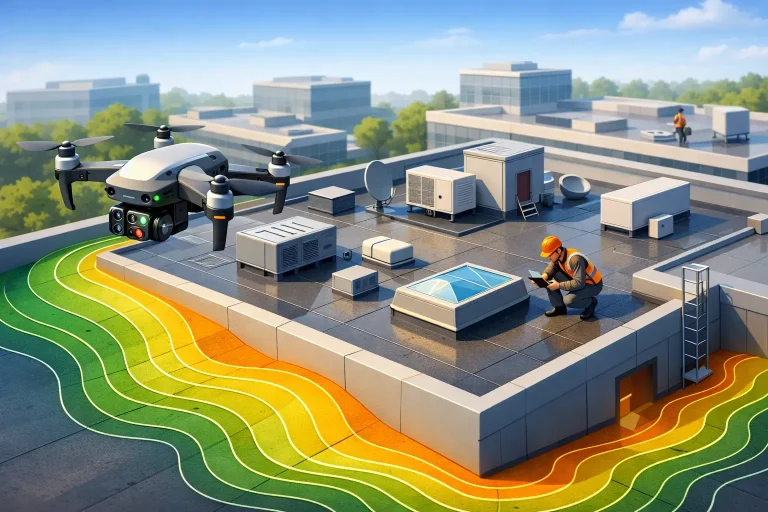
A well-timed inspection programme protects more than the building fabric. It gives asset managers clearer evidence for budgeting, helps contractors scope work accurately and reduces the safety risks of reactive access. Drone roof surveys add a further advantage by capturing high-resolution visual data without routine work at height, making it practical to assess large, complex or difficult-to-access roofs more regularly.
When to inspect commercial roofs
For most commercial properties, a professional roof inspection should take place at least twice a year: once after winter and once before the wetter, colder months begin. In the UK, this usually means a spring inspection and an early autumn inspection.
Spring reveals the effect of winter weather. Freeze-thaw cycles, high winds, prolonged rainfall and debris accumulation can all compromise finishes, flashings, gutters and drainage points. An inspection at this stage identifies defects before summer heat can worsen movement in roof coverings or before a small drainage issue becomes persistent ponding.
An autumn inspection is equally valuable. It confirms that outlets, gullies and gutters are clear before falling leaves and seasonal storms create blockages. It also gives facilities teams time to schedule repairs in favourable conditions, rather than competing for emergency contractor availability during severe weather.
That twice-yearly baseline is not a substitute for judgement. A warehouse with a large flat roof, numerous rooflights and extensive drainage runs has a different risk profile from a small, pitched office roof. Older buildings, roofs approaching the end of their expected service life and properties carrying solar arrays or heavy mechanical plant may require more frequent review.
Inspect after severe weather
A planned programme should always be supplemented by event-led inspections. High winds can loosen edge trims, displace tiles, damage roof-mounted equipment and lift membrane seams. Heavy rain can expose poor falls, blocked outlets and areas where water is entering at penetrations. Snow and ice may stress drainage systems and reveal weaknesses around joints.
An aerial inspection is particularly effective after a storm because it can provide a rapid overview of the whole roofscape. Rather than relying on a ground-level visual check, facilities teams can see the condition of parapets, valleys, rooflights, plant enclosures and inaccessible elevations. This is useful when the roof is unsafe to access immediately or when a site needs evidence for insurers, landlords or contractors.
Inspect before lease events, refurbishments or acquisitions
Commercial roof condition has a direct bearing on dilapidations, planned capital expenditure and building value. Before taking a lease, purchasing a site, commencing a refurbishment or handing a property back, an inspection provides a defensible record of visible condition.
This is not simply about identifying leaks. A survey can highlight deterioration around penetrations, temporary repairs, damaged cladding interfaces, poor drainage and areas affected by previous works. Where a roof is due to receive solar panels, new HVAC equipment or communications infrastructure, inspection data also supports safe design and access planning. Installing new equipment onto an ageing roof without understanding its current condition can create avoidable liability and future maintenance complications.
Inspect after works on or near the roof
Any project involving roof access deserves a follow-up inspection. Trades working on plant, solar installations, signage, façades or gutters can unintentionally damage coverings, puncture membranes or alter drainage paths. Construction activity nearby may also deposit debris onto the roof or cause vibration-related movement to vulnerable details.
A pre-works aerial record establishes baseline condition. A post-works inspection then provides a clear comparison, helping project managers confirm that the roof has been left in acceptable condition. For multi-contractor sites, this evidence can be especially valuable when responsibility for defects is unclear.
What a commercial roof inspection should assess
The purpose of inspection is not merely to collect photographs. It is to turn visible conditions into maintenance decisions. A useful survey should identify defect location, likely cause, severity and the practical action required.
On flat roofs, the assessment should consider membrane condition, seams, upstands, flashings, parapet copings, expansion joints, rooflights, penetrations and signs of standing water. Drainage deserves close attention. A blocked outlet can often be rectified quickly, but repeated ponding may point to inadequate falls, structural movement or a broader failure in the roof build-up.
Pitched roofs require a different focus. Slipped or cracked tiles, damaged ridge details, open valleys, failing leadwork and defective gutters can allow water beneath the primary covering. From above, an aerial survey can also reveal patterns that are difficult to see from ground level, such as widespread tile movement on a large industrial unit or deterioration around roof-mounted plant.
The surrounding elements matter too. Water often enters a building at interfaces rather than across the central roof area. Inspecting walls, cladding junctions, gutters, downpipes, skylights and service penetrations provides a more reliable picture of where risk is developing.
Why inspection frequency depends on the building
There is no single schedule that fits every commercial roof. The right frequency depends on the roof type, age, surrounding environment, building use and consequences of failure.
A distribution facility storing valuable goods may need a more cautious regime than a low-occupancy storage building. A golf clubhouse may have complex pitched sections, flat-roofed extensions, rooflights and drainage routes close to mature trees. Leaves, moss and storm debris can make regular drainage checks particularly relevant, while a visible leak in hospitality or changing areas can quickly affect the member experience and day-to-day operation.
Location also changes exposure. Coastal sites contend with wind-driven rain and salt-laden air. Urban buildings may have restricted access, more rooftop plant and greater debris accumulation. Properties beneath mature trees are more susceptible to blocked gutters and outlets. A roof that has already experienced recurring leaks should move to a more frequent monitoring cycle until the underlying cause is resolved.
Drone surveys improve the quality of roof decisions
Traditional inspections remain necessary where hands-on testing, moisture investigation or repair work is required. However, sending personnel onto a roof for every visual check is not always proportionate, particularly where fragile rooflights, steep pitches or extensive plant create hazards.
Professional drone inspection provides a safer and more efficient first view. High-resolution imagery can document the full roof area, including details that may be missed from ladders or distant ground positions. Orthomosaic outputs can create an accurate, measurable overhead record, allowing maintenance teams to mark defect locations, compare condition over time and communicate clearly with contractors.
The trade-off is that aerial imagery cannot confirm every concealed issue. A drone can identify cracking, displaced materials, blocked drainage and visible water staining, but it cannot replace intrusive testing where damp is trapped within the roof system. The strongest approach is often a staged one: use aerial data to identify and prioritise risk, then direct physical investigation only where it is genuinely needed.
For larger estates, consistent imagery also makes condition monitoring more useful. Repeat surveys taken from comparable viewpoints can show whether ponding is increasing, whether a repair is holding or whether deterioration is spreading around a roof penetration. This turns roof maintenance from a sequence of isolated repairs into an evidence-led asset strategy.
Turning findings into a maintenance plan
Inspection has value only when findings lead to action. Defects should be classified by urgency: immediate safety or water-ingress risks, repairs needed within the current maintenance cycle, and conditions to monitor at the next survey. Photographs should be paired with clear location references so that a contractor can price and undertake the right work without ambiguity.
Keep the inspection record alongside previous reports, repair invoices and weather-related incident notes. Over time, this history helps reveal whether expenditure is addressing root causes or simply repeating short-term patch repairs. It also supports more realistic lifecycle budgeting, particularly where roof replacement may be more cost-effective than escalating reactive maintenance.
Vantage Imagery Limited delivers precision aerial roof inspections that give commercial property and facilities teams a clear visual record of roof condition, supporting safer access planning and better-informed maintenance decisions.
The best time to inspect is before a defect becomes visible inside the building. Put a spring and autumn survey in the diary, add inspections after major weather or roof works, and use the resulting evidence to plan the next sensible action while choices and budgets are still under control.
